

Ask a room of renovation-firm owners how many leads they need a month and you'll get one of two answers: a shrug, or a round number pulled from the air. Then they set an ad budget the same way — a figure that feels affordable — and hope enough enquiries show up. It's the single most common planning mistake in this business, and it's entirely avoidable.
The right way to find your lead target is to reverse the funnel: start with the take-home you want, work backwards through tax, overhead, job value and your close rate, and out drops a concrete monthly enquiry number. Do it once and two things usually surprise owners — the number is smaller than they feared, and the fastest way to hit it isn't more leads at all. Let's build it with Malaysian figures.
Why do most owners get the lead number wrong?
Because they set it forwards, from spend, when the only honest way to set it is backwards, from the goal. A forwards budget asks "what can I afford to spend on ads?" and treats whatever leads arrive as the plan. That tells you nothing about whether those leads add up to the year you actually need — the take-home, the jobs, the payroll you have to cover.
Reversing the funnel flips the question. Instead of "how many leads will this budget buy?", you ask "how many leads does my goal require?" — and then you find out whether your current pipeline is anywhere near it. This isn't a HotLead idea; it's standard sales-planning practice (marketing teams call it a reverse funnel or reverse-engineered revenue plan), the discipline that turns a vague revenue wish into a number your inbox can be measured against. What's missing everywhere online is the version with Malaysian reno numbers in it — the real tax bands, the real job values, the real close rate. So here it is.
How do you work backwards from take-home to a lead target?
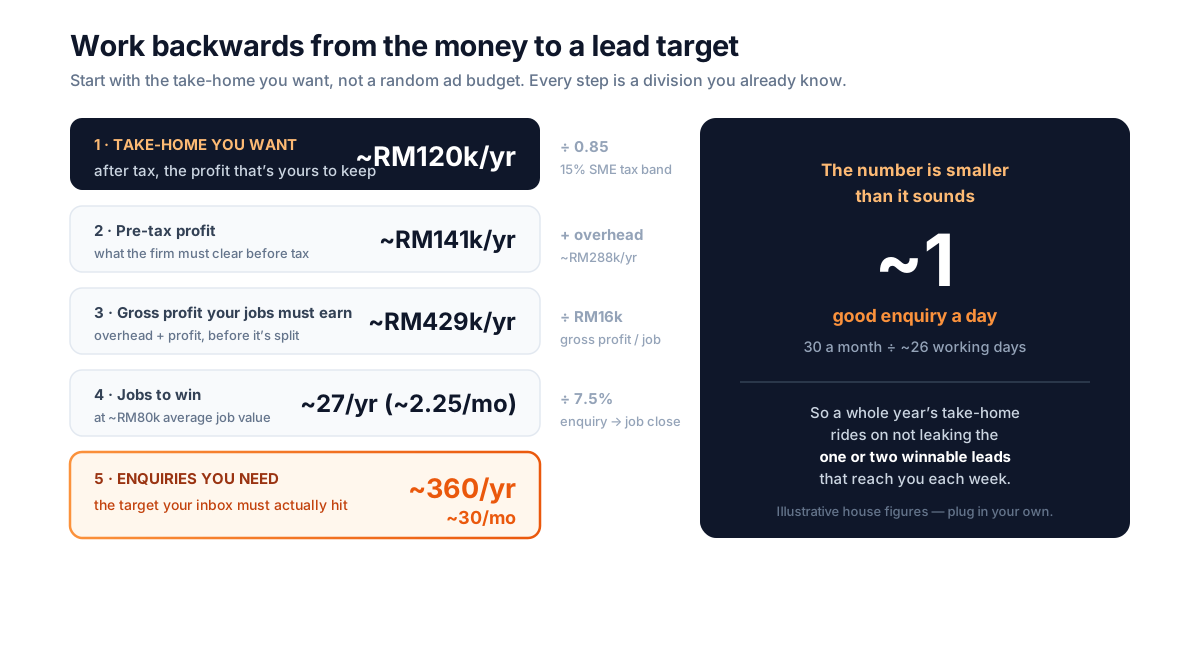
Start at the top — the money you actually want — and divide your way down. Five steps, each one a number you already half-know.
- Decide your take-home. Not revenue — the profit that's actually yours to keep in a year, after every cost the business carries (including a fair wage for yourself, which sits inside overhead) and after tax. Say you want RM120,000 a year to keep.
- Gross it up for tax. For a qualifying Malaysian SME, the first RM150,000 of chargeable income is taxed at 15%, so to keep RM120k the firm must clear about RM120k ÷ 0.85 ≈ RM141,000 pre-tax. (Bigger goals climb the staircase — see the note below.)
- Add your overhead. Pre-tax profit is what's left after fixed costs, so add them back to find the total gross profit your jobs must generate. On an illustrative RM24,000-a-month overhead (~RM288,000 a year — rent, office staff loaded with EPF/SOCSO, your own wage, van, software), that's RM141k + RM288k ≈ RM429,000 of gross profit the jobs have to earn.
- Divide by gross profit per job. At an RM80,000 average job on a ~20% gross margin, each job contributes about RM16,000 gross profit. RM429,000 ÷ RM16,000 ≈ 27 jobs a year — a little over 2 a month.
- Divide by your close rate. At a 7.5% enquiry-to-job close rate, 27 jobs needs 27 ÷ 0.075 ≈ 360 enquiries a year — about 30 a month, or a little over one genuine enquiry a working day.
Here's the same calculation laid out as a table, so you can drop your own figures into the right-hand column:
| Step | Illustrative figure | Your number |
|---|---|---|
| Take-home you want (after tax) | RM120,000 / yr | ______ |
| ÷ 0.85 → pre-tax profit needed | ~RM141,000 / yr | ______ |
| + annual overhead | + RM288,000 | ______ |
| = gross profit the jobs must earn | ~RM429,000 / yr | ______ |
| ÷ gross profit per job (RM80k × ~20%) | ÷ RM16,000 | ______ |
| = jobs to win | ______ | |
| ÷ close rate | ÷ 7.5% | ______ |
| = enquiries needed | ______ |
Why is your close rate the honest lever, not more leads?
Because the two divisions at the bottom of the funnel do far more work than the ad budget at the top. Look at what happens to the enquiry target when only the close rate changes and everything else stays put:
| To win ~27 jobs a year, at a close rate of… | Enquiries needed / year | Enquiries / month |
|---|---|---|
| 5% | ~540 | ~45 |
| 7% | ~386 | ~32 |
| 7.5% (worked example) | ~360 | ~30 |
| 10% | ~270 | ~23 |
| 12% | ~225 | ~19 |
Lifting your close rate from 7% to 10% cuts the enquiries you need by about a third — roughly 116 fewer a year — for the same number of jobs and the same take-home. That is a stunning return, and it costs no ad budget. It's the same lesson as "you can't out-spend a leaky funnel": a firm chasing its number by buying ever more leads while winnable ones die on slow replies is paying full price to refill a leaking bucket.
And on a reno funnel, three points of close rate is rarely exotic. The overall 7–8% is six stage rates multiplied together, so lifting the weakest stage — usually booking the consultation or chasing the quiet quote — moves the whole number. Which is why the honest first question isn't "how do I get 30 leads a month?" but "of the leads I already get, how many am I losing that I shouldn't?"
Why a raw lead target is a trap: the two ceilings
Here's the trap in a "just get more leads" mindset: it assumes you can convert every extra enquiry into a job. You can't — and this series has already mapped exactly why. A lead target isn't an open-ended "more is better" number. It's bounded top and bottom.
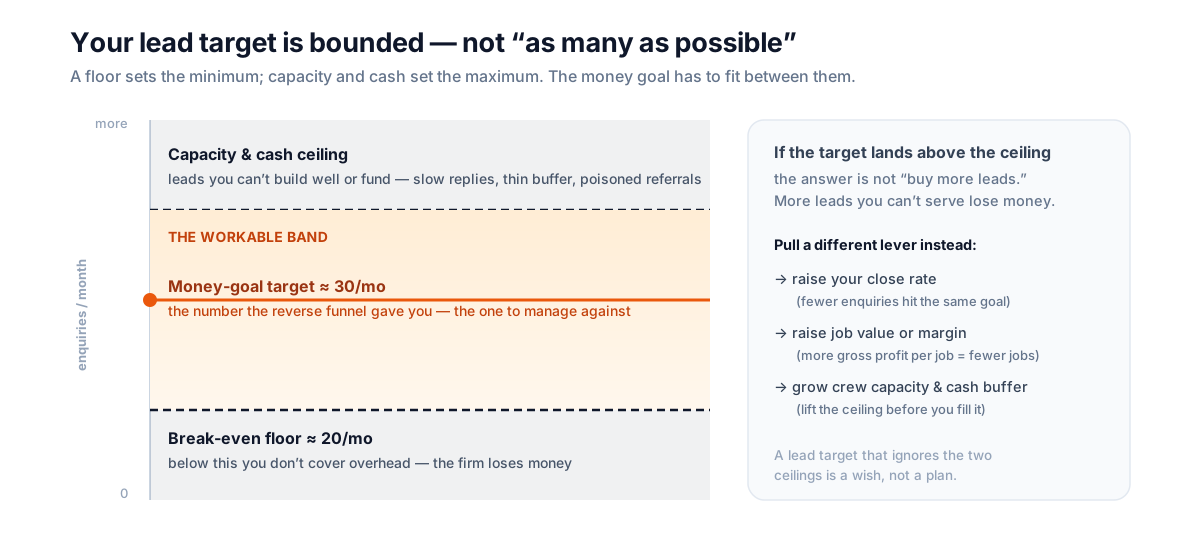
The floor is break-even. Below a certain number of jobs you don't cover overhead at all. On the worked figures, break-even is about 1.5 jobs a month — roughly 20 enquiries a month at a 7.5% close, just to reach zero. Every enquiry above that floor is where your take-home actually comes from, which is why the operating leverage is so steep: the jobs past break-even drop almost entirely to profit.
The ceiling is capacity and cash — two separate walls. You can only win as many jobs as you can deliver well, because crew-weeks, not leads, are the binding constraint for a small firm. And you can only take on as many jobs as you can fund, because every live job ties up your own cash between milestones — win more than your buffer covers and you hit the profitable-but-broke wall. Buy leads past either ceiling and the surplus doesn't become jobs; it becomes slow replies, rushed visits, thinner margins on overloaded crews, and a word-of-mouth engine you're quietly poisoning.
So the reverse-funnel target has to fit inside the band. And this is the genuinely useful part: if your money goal needs more jobs than you can build or fund, the answer is never "buy more leads." It's to lift a different dial — raise your close rate, raise job value or margin so each job carries more, or deliberately grow crew capacity and your cash buffer before you fill them. A lead target that ignores the two ceilings isn't a plan; it's a wish that ends in a flooded inbox and a bad quarter.
So what number should you actually manage against?
The daily one. Thirty enquiries a month ÷ about 26 working days is a little over one genuine enquiry a day. That reframes the whole problem. You're not trying to become a lead-generation machine — you're trying to make sure the one or two winnable leads that reach you each day don't leak. At that scale, losing two good enquiries a month — a forgotten follow-up here, a Saturday enquiry nobody replied to there — can be the difference between hitting your take-home and missing it.
How HotLead fits in
HotLead doesn't set your revenue goal or do your reverse-funnel sum — that's your plan, and now you have the method for it. What it does is make the two numbers the whole calculation turns on visible and defensible, so you're managing against a real figure instead of a guess. It captures every enquiry with its source attached and tracks it to won or lost, so your actual monthly enquiry count and your close rate by source stop being a feeling and become a number you can hold against your target. Its funnel and per-channel view shows you whether you're short on leads or short on close rate — the difference between the Klang owner buying ads he didn't need and fixing the stage that was actually costing him. And because the daily target is so small, HotLead keeps first replies fast and every lead owned with a clear next action and overdue nudges, so the one or two winnable enquiries a day don't quietly leak away.
Start with the complete guide to managing renovation leads in Malaysia, see the renovation lead playbook, or go deeper on the four numbers every reno firm should track and how much you should really spend on marketing.
Sources: Reverse-funnel / reverse-engineered revenue-plan method (start from the revenue goal, divide by deal size for deals, by win rate for leads) — TTEC reverse-funnel & revenue calculator, Interodigital and LeadG2 (The Center for Sales Strategy) reverse-engineering guides. Malaysian SME corporate tax (first RM150k of chargeable income at 15%, RM150k–600k at 17%, above RM600k at 24%; qualifying if paid-up capital ≤ RM2.5m and gross income ≤ RM50m) — Funding Societies, Arnifi and Calculator Malaysia summaries of the Year of Assessment 2026 rates; confirm your effective rate with your accountant. Healthy home-improvement close rate (7–8% overall, six funnel stages multiplied; referral ~15–25% vs cold ~1%) and the ~RM1,280 expected gross profit per enquiry are the illustrative house figures used across this series (see our funnel-stage benchmarks). Word of mouth as the ~49% top discovery channel for Malaysian reno buyers — ZenWeb Malaysian renovation buyer survey. Overhead (RM24k/mo), break-even (1.5 jobs/mo), average job value (RM80k), gross margin (20%), gross profit per job (RM16k), fully-loaded CAC (~RM2,025) and crew-week/working-capital ceilings are the illustrative house figures from the break-even, profit-per-crew-week and working-capital pieces — plug in your own take-home, overhead, job value, margin and close rate to get your real monthly lead target.
Frequently asked questions
How many leads does a renovation firm need per month in Malaysia?
There's no universal number — it depends on your revenue goal, your average job value and your close rate. But you can calculate your own precisely by reversing the funnel. On illustrative house figures for a small Malaysian reno firm (a RM120k-a-year take-home target, RM24k a month overhead, RM80k average job at ~20% gross margin, and a 7.5% enquiry-to-job close rate), the firm needs about 27 jobs and roughly 360 enquiries a year — about 30 enquiries a month, or a little over one genuine enquiry a working day. Plug in your own numbers and the method gives you your target, not a benchmark to copy.
How do I work out my own monthly lead target?
Five steps. (1) Decide your annual take-home — the profit that's yours to keep after every cost, including a fair wage for yourself. (2) Gross it up for tax (for a qualifying Malaysian SME, the first RM150k of chargeable profit is taxed at 15%, so divide by 0.85). (3) Add your annual overhead to get the total gross profit your jobs must earn. (4) Divide by your gross profit per job (roughly job value × gross margin) to get jobs a year. (5) Divide by your close rate to get enquiries a year, then by 12 for a monthly target and by working days for a daily one.
Is it better to get more leads or improve my close rate?
For most small reno firms, improve the close rate first. It's pure arithmetic — if you need 27 jobs a year, at a 7% close rate that's about 386 enquiries; at 10% it's 270. Lifting your close rate by three points cuts the enquiries you need by roughly a third, at no extra ad spend. Buying that many more leads costs real money every month, while tightening reply speed, ownership and follow-up costs mostly effort and pays back in weeks.
Why can't I just buy as many leads as possible?
Because two ceilings cap what you can convert. The first is delivery capacity — you can only build so many jobs well with your crews, and leads past that point get slow replies and rushed visits. The second is your working-capital buffer — every live job ties up your own cash between milestones, so winning more jobs than you can fund is the classic profitable-but-broke wall. A lead target that ignores those two ceilings is a wish, not a plan. If your money goal needs more jobs than you can build or fund, the fix is to raise job value, margin or close rate — not to pour in more leads.
What close rate should a Malaysian renovation firm expect?
A healthy overall enquiry-to-job conversion for home-improvement work is around 7–8%, though it varies enormously by lead source — a warm referral might close at 15–25% while a cold boosted-post lead closes closer to 1%. Because the source mix swings the blended rate so much, work out your target on your own measured close rate rather than the industry average, and track it by source so you can see which channels actually move the number.
Keep reading
- Did We Already Say RM68k? Using AI to Stop Quote Drift Across a Long Renovation ThreadOver a weeks-long WhatsApp thread with two or three quote revisions, a rep re-states a number that contradicts an earlier promise — and re-opening a settled price quietly invites a discount that eats a whole job's profit. So I pointed AI at the drift. It works beautifully as a flag, and dangerously as an auto-corrector.
- The Warranty as a Closing Lever: Why a Longer Guarantee Beats a Discount on a Renovation DealA quote is stalling and the buyer wants a reason to say yes. Before you drop the price, look at the other lever in your hand — a longer workmanship warranty. It is the same expected-value decision as a discount, but the math runs the opposite way — a price cut costs you thousands with certainty, while extending the defects cover costs you a couple of hundred ringgit in expectation, for arguably more trust with a scam-wary buyer. Here is the EV case for the non-price concession, the trap that turns it into a hidden liability, and which leads it actually moves.
- "Can You Just Build It, My Neighbour Also Did" — Handling the Renovation Lead That Needs Council Approval FirstSome renovation enquiries can't legally start next month, no matter how ready the buyer is — a kitchen extension, a hacked-through wall, a roofed-over air well all need the council's written approval first. Quote a fast build price to win the job and you either lose it to a "boss, can start" cowboy, or win it and inherit the stop-work order, the RM50,000 fine and a client who later can't sell the house. Here's how to spot the permit-first lead and sell the approval as protection.