

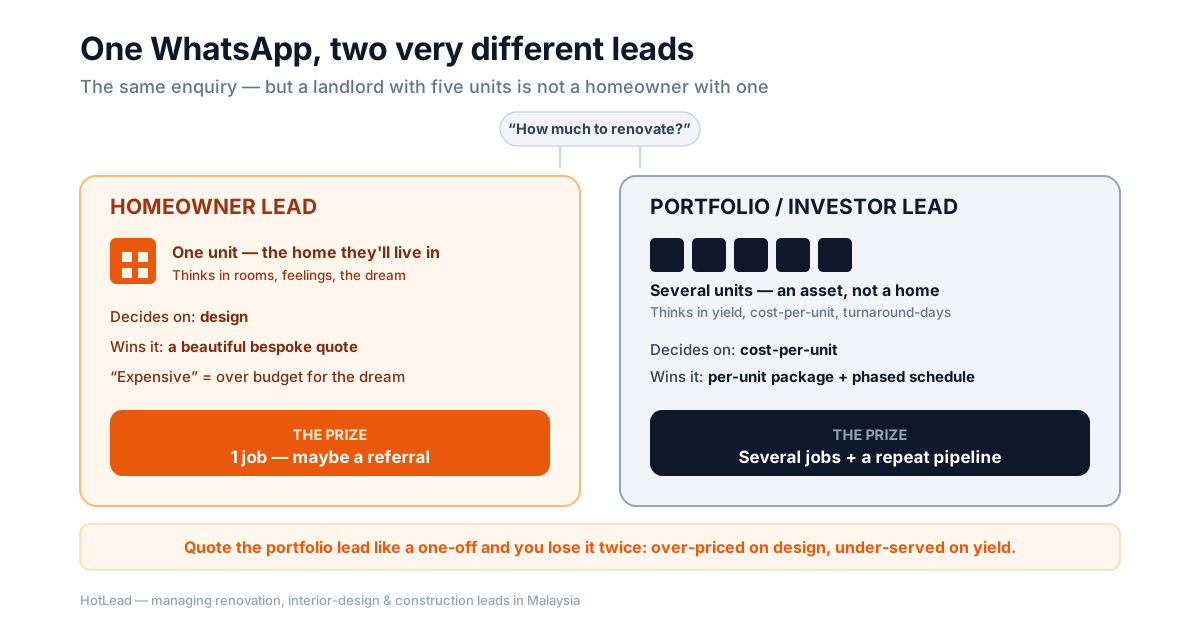
A contractor in Cheras told me about the "small job" that turned out to be five.
A WhatsApp came in: "Hi, how much to renovate a condo unit in Sri Petaling? Kitchen and both bathrooms, nothing fancy." Straightforward. He did what he does with every homeowner enquiry — booked a visit, measured up, and put together a proper quote: a nice custom kitchen, a feature wall he thought she'd love, quality finishes. Around RM85k. He was proud of it.
She went quiet, then replied a week later: "Thanks, but I went with another firm. I've got three units in the same block, all rented out, and they gave me one package price per unit and a schedule so I only lose one tenant at a time. Yours was for one dream kitchen."
He hadn't lost on price, exactly. He'd lost because he answered a portfolio lead as if it were a homeowner lead. He quoted her a home; she was buying yield. He priced one unit beautifully; she needed three priced repeatably. The best lead he'd had all month walked in disguised as the smallest, and he never saw it.
That's the trap I want to walk through, because in Malaysia this lead is everywhere — and it almost always arrives wearing a single-homeowner costume.
What is a portfolio lead, and how is it different from a homeowner lead?
A portfolio lead is a landlord, short-stay operator or small property investor who wants several units renovated — a distinct lead type with different economics and a different close, not a bigger version of a homeowner job. Same WhatsApp, completely different buyer.
A homeowner is renovating the place they'll live in. They think in rooms, feelings and their family's routine; the decision is emotional and personal; it's one job, and the win, at best, is a referral. A portfolio buyer is renovating an asset. They think in yield, cost-per-unit and turnaround-days; the decision is coldly financial; and it's not one job — it's several, plus a repeat pipeline every time they buy another unit or turn over another tenant.
This isn't a niche corner of the market, either. Malaysia's home-ownership rate sits around 78% (DOSM, 2024), but a growing slice of stock is bought to let: NAPIC's 2025 data shows 30,471 completed unsold residential units worth RM17.73 billion, up 31.6% year-on-year, with condominiums and apartments making up 47.1% of them. A lot of that overhang is being picked up in bulk by investors and short-stay operators — and every one of those units needs a fit-out before it earns a cent.
Why does a portfolio lead read like a single homeowner?
Because it arrives through the same WhatsApp, in the same words, and usually tests you with a single unit before revealing the rest. An investor rarely opens with "I have five units." They open with "how much to do one," to see how you handle it.
There are three reasons the disguise holds. First, the channel is identical — a landlord and a homeowner both message the same signboard, the same Qanvast profile, the same FB ad. Second, investors are deliberately low-key; they've learned that saying "I've got a portfolio" invites a higher price, so they'll float one unit and watch. Third — and this is the one that costs firms money — the enquiry is short and unemotional, and a busy firm reads "short and unemotional" as "small and unserious," and gives it the fast, casual handling a small job gets.
So the very signals that mark a portfolio lead — no talk of family, no dream kitchen, just cost-per-unit and speed — are the ones a firm misreads as a tyre-kicker. You end up giving your most valuable lead your least attention, the same perverse inbox rule that makes firms slow-walk warm referrals because they "already trust us".
Why does a bespoke single-unit quote lose the portfolio?
Because it misses on two opposite axes at once — it over-prices the buyer and under-serves them in the same message. This is the part that stings: you can lose a portfolio lead with a quote that's simultaneously too expensive and not enough.
It over-prices because an investor isn't buying design. A custom kitchen, a feature wall, premium finishes — the things that win a homeowner — are pure cost to a landlord protecting a ~4.6% gross yield on a KL condo. A tenant won't pay more rent for marble; they'll pay for clean, durable and move-in-ready. Every ringgit of flair you add is a ringgit off the buyer's return, so your beautiful RM85k quote reads as expensive and slightly clueless.
And it under-serves because it answers none of the questions a portfolio buyer actually has: What's the price per unit so I can multiply it across my block? Can you schedule the units so I only lose one tenant at a time? Who's my single point of contact for all of them? A one-off quote is silent on all three. So you look costly to the buyer who wants yield, and unhelpful to the buyer who wants a system — and the firm that quoted the portfolio, even at a higher per-unit number, wins.
What does a portfolio buyer actually care about?
Yield, cost-per-unit, and turnaround-days — the numbers that decide whether their asset makes money — not the things a homeowner cares about. Speak their language and you're immediately the firm that "gets it."
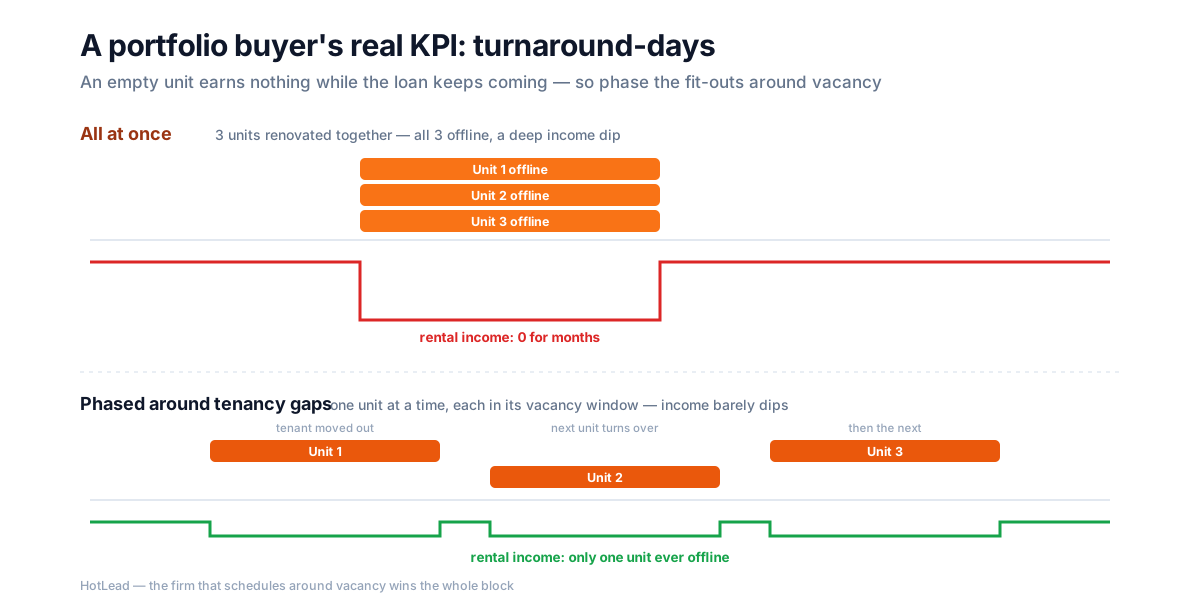
- Turnaround-days. A rental unit in Malaysia commonly sits empty 60–90 days between tenants, and an empty unit earns nothing while the loan instalment keeps coming. To an investor, a fit-out that drags an extra two weeks isn't an inconvenience — it's real lost rent. Fast, predictable delivery is worth more to them than a fancier finish.
- Cost-per-unit, not total. They're building a number they can multiply across the block and check against the rent it'll command. A rent-ready investor package of roughly RM30k–50k covering kitchen, bathrooms, paint, flooring and aircon is a far better answer than a one-off custom quote — it's a unit they can price, repeat and finance.
- Durability over design. Tenant-proof surfaces, easy-clean finishes, fittings you can source again in two years when one breaks. A landlord thinks about the maintenance call in month eight, not the Instagram photo on day one.
- One point of contact. Someone who remembers their building, their standard finishes, their access arrangements — so unit two doesn't start from zero. Consistency across units is the product.
Homeowner lead versus portfolio lead — the reflexes that flip
Run a portfolio lead through your homeowner reflexes and you'll misprice it and under-serve it. Here's how the two differ, and why nearly every winning move flips — the same way the reflexes flip on a strata committee job or a tender versus a direct lead.
| Homeowner lead | Portfolio / investor lead | |
|---|---|---|
| Who's buying | A resident, for themselves | An operator, for an asset |
| What they optimise | How it looks and feels | Yield, cost-per-unit, turnaround-days |
| The scope | One bespoke unit | Several units, repeatable |
| What wins it | A beautiful custom design | A per-unit package + a phased schedule |
| What "expensive" means | Over budget for the dream | Anything that dents the yield |
| The real prize | This job, maybe a referral | The whole block + a repeat pipeline |
| Right point of contact | Whoever's free | One owner who knows the portfolio |
How do you spot a portfolio lead on the first reply?
Listen for the language of an operator instead of a resident — units, packages, speed and yield instead of rooms, feelings and dreams. The tells are consistent, and you can catch them in the first two messages if you're listening for them.
Watch for: "how much per unit", "do you have a standard package", "how fast can you turn around between tenants", "I have a few units in the same block", "just need it rent-ready", "what's the fastest you can finish". Notice what's missing too — no mention of living there, no family, no "we've always wanted." A homeowner can't help revealing the dream; an investor keeps it to the numbers.
When you hear those signals, ask one or two questions that both qualify the lead and prove you understand their business: "Is this for rental or short-stay?" and "How many units are we talking about, and are they in the same building?" If they say short-stay, ask whether the building actually allows it — Malaysia has no single national short-term-rental law, and a building's MC or JMB can restrict or ban Airbnb-style letting under its strata by-laws even where the council permits it. That one question marks you as a contractor who understands their model, not just their walls.
How should you handle a portfolio lead to win the whole block?
Handle it as its own lead type — one contact, a repeatable per-unit price, and a phased schedule built around vacancy — and price the first unit to win the relationship, not the margin. Five moves:
- Tag it as a portfolio lead the moment you spot it — not a fresh homeowner job. That one label routes it away from the bespoke-quote reflex and towards a package-and-schedule conversation. It's a distinct lead type, like a strata committee job or a takeover of an abandoned renovation.
- Give it one point of contact — the same person across every unit. A portfolio buyer is a relationship, and relationships die in a group chat where no one owns the lead. One owner who remembers the building, the finishes and the access is half of why they stay with you.
- Build a repeatable per-unit price, not a bespoke quote. Give them a clear package they can multiply and check against the rent — a rent-ready spec with durable finishes and a fixed number per unit. Repeatability is the value; it's what lets them plan a whole block.
- Phase the schedule around tenancy gaps. Renovation lag is your friend here: sequence the units so only one is offline at a time, slotting each into its vacancy window so the investor's rental income barely dips. This is exactly the kind of forward-booked, future-dated pipeline that also fills your quiet months when you're not fully booked.
- Price and run the first unit to win the portfolio. The prize is units two through five and the repeat pipeline, not the margin on unit one. A sensible per-unit price that wins the block beats squeezing full retail out of the first bathroom and never seeing the rest. Lock serious intent with a booking deposit and clear staged payment terms, and make the future-dated units visible so none of them quietly falls off.
When is a portfolio lead not worth chasing?
Walk away when the numbers can't work — the yield-squeezer who wants rock-bottom per-unit with no margin, the buyer who can't fund the rollout, or the "few units" that never materialise. Not every investor lead is a good account, and volume at a loss is still a loss.
Good signs it's worth it: real units you can verify, a clear budget per unit, a buyer who values speed and consistency over the cheapest possible number, and units close enough together to schedule efficiently. Be wary when the buyer only wants the absolute floor price and treats every ringgit of margin as waste — a portfolio of thin, rushed jobs can damage your reputation across a whole building. Be wary too when the "five units" is vague and always next year, or when the funding clearly isn't there yet. As with any lead you're better off not chasing, the discipline is to price the relationship you actually want, not the volume you're being dangled.
How HotLead helps you catch portfolio leads before you quote them like one-offs
HotLead sits on top of the WhatsApp your enquiries already land in — nothing changes for the investor messaging you — and it's built so a high-value portfolio lead gets handled on the right process instead of being quoted like a walk-in:
- Captures and tags every enquiry the moment it arrives, so a "how much per unit" or "I have a few units" message can be marked as its own lead type and routed into a package-and-schedule conversation, not the bespoke-quote lane.
- Assigns one owner instantly — round-robin, manual, or a custom rule we set up during onboarding — so a portfolio buyer deals with one point of contact who builds the relationship across every unit, instead of a different person each time.
- Keeps a next action and flags overdue follow-ups, so the phased units, the second-unit conversation, and the next-handover enquiry all get tracked — the touches a repeat account lives or dies on.
- Shows your funnel and per-channel ROI, so you can see which portfolio leads are live, what the whole-block pipeline is worth, and whether investor work is a profitable, repeatable lane for your firm.
HotLead doesn't build the per-unit package or schedule your crew — that's your pricing and your operations, and on a portfolio lead it's the whole game. What it does is make sure the lead that arrived looking small gets caught, tagged and owned before someone on your team fires back a single-unit dream-kitchen quote and loses the block.
If your firm keeps quoting "small" condo jobs that turn out to be the tip of a five-unit portfolio you never won, the leak usually isn't your pricing — it's that you answered an investor like a homeowner and never saw the block behind the unit. Start with the renovation lead-management hub, the contractor hub or the interior-design hub, read the complete guide to managing renovation leads in Malaysia, or see how HotLead works.
Sources: Malaysia's completed-unsold residential overhang — 30,471 units worth RM17.73 billion, up 31.6% year-on-year, with condominiums and apartments at 47.1% of unsold completed homes — from NAPIC's 2025 Property Market Report as reported by Property Genie — NAPIC Q3 2025 Malaysia Property Market Report. National home-ownership of around 78% in 2024 from The Edge Malaysia / DOSM. Average gross rental yields — roughly 5.19% nationally and about 4.6% for KL condominiums, with mid-range and compact units outperforming luxury — from PropertyGuru — Rental Yield Trends in Malaysia and Global Property Guide — Malaysia rental yields. The commonly cited 60–90 day vacancy period between tenants from Speedhome — fill-time comparison. Investor rent-ready condo renovation packages of roughly RM30,000–50,000 covering kitchen, bathrooms, paint, flooring and aircon from PropCashflow — Renovation Costs in Malaysia 2026. Short-term rental in Malaysia having no single national law, with local authorities and a building's MC/JMB strata by-laws able to restrict or ban Airbnb-style letting, from iProperty — Is Short-Term Rental (Airbnb) Legal in Malaysia. The Cheras, Sri Petaling and JB/CIQ scenarios are illustrative; the pattern is one we see repeatedly.
Frequently asked questions
How do I tell a portfolio investor lead from a normal homeowner enquiry on WhatsApp?
Listen for the language of an operator, not a resident. A homeowner talks about their family, their dream kitchen, how they want it to feel. A portfolio buyer talks in units and numbers - "how much per unit", "do you have a standard package", "how fast can you turn it around between tenants", "I have a few units in the same block", "just need it rent-ready". They rarely mention living there. If the enquiry is oddly unemotional and keeps circling cost-per-unit and speed, you're almost certainly talking to a landlord, a short-stay operator, or a small investor - and that's a multi-unit lead wearing a single-unit disguise.
Why does quoting a bespoke single-unit job lose a portfolio lead?
Because it misses on two opposite axes at the same time. It over-prices the buyer, who isn't buying design flair - they're protecting a rental yield, so a beautiful RM90k custom kitchen is a worse answer than a repeatable RM35k rent-ready package. And it under-serves them, because it says nothing about the things a portfolio buyer actually needs - a per-unit price they can multiply, a phased schedule that fits around tenancy gaps so rental income barely dips, and one point of contact for the whole rollout. You look expensive and unhelpful in the same message, and they go with the firm that quoted the portfolio.
Should I discount the first unit to win a multi-unit renovation job?
Often yes, if you're pricing to win the portfolio rather than to buy the job at a loss. The value of a portfolio lead isn't unit one - it's units two, three, four, and the repeat pipeline when the same investor buys the next unit or turns over the next tenant. A sensible per-unit price that wins the whole block, plus a genuine reason to keep coming back to you (you already know their building, their finishes, their fittings), beats squeezing full retail margin out of the first bathroom and never seeing the other four. What you should not do is quote below cost to win volume you can't deliver profitably - that's how a portfolio lead becomes a portfolio of loss-making jobs.
A short-stay/Airbnb operator wants me to renovate several units. Anything I should check first?
Yes - ask whether short-term rental is actually allowed in that building before you design for it. Malaysia has no single national short-term-rental law; each local authority sets its own rules, and even where a council permits it, a building's Management Corporation (MC) or Joint Management Body (JMB) can restrict or ban Airbnb-style letting under its strata by-laws. If the by-laws prohibit short-stay, an operator's whole plan can change, and so does the fit-out. Asking early marks you as a contractor who understands their business, not just their walls - and it's the same committee-and-by-laws world you deal with on a strata building-works job.
Is a portfolio lead worth more than a homeowner lead?
Usually far more, because one close can be several jobs plus a repeat pipeline - but only if you handle it as a relationship, not a transaction. A single homeowner is typically one job and, at best, a referral. A landlord with five units, a short-stay operator scaling up, or an investor who buys a unit or two a year is recurring revenue for a firm that becomes their default renovator. The catch is that this lead is also the easiest to fumble, because it arrives looking small and gets the casual handling a small job gets. Recognise it for what it is on the first reply and it can quietly become the most valuable account your firm has.
Keep reading
- "Can Discount Ah?" Can AI Spot a Price-Shopping Renovation Lead — and Should It Decide the Next Move?A Puchong contractor gets "another firm quoted me RM55k, can match or not?" at 10pm and does what a tired owner does — he knocks RM6k off to not lose it. He's trained that buyer, and the ten after her, to push. So the 2026 reflex is to ask AI to read the thread, flag the price-shoppers, and either auto-discount to win them or bin them as tyre-kickers. I built it. It mislabels your best buyer as a time-waster and your margin as negotiable — because the signal is in the chat but the right move never is. Here's the build that earns its keep, and why "can discount ah?" is the start of a conversation, not a verdict.
- What a Referred Lead Is Actually Worth — and Why Your Best Ringgit Protects ItA referral isn't just a "free" lead — it wins on cost, close rate and lifetime value at the same time, and those three advantages multiply. Here's what a referred renovation lead is really worth against a paid one, why owners under-fund their single best channel, and why the highest-return marketing ringgit protects the referral engine instead of buying more cold strangers.
- "Boleh Buat Macam Ni Tak?" — The Expensive-Look, Small-Budget ID Lead in MalaysiaA homeowner sends a saved Instagram image of a RM250k penthouse look and asks for it on a RM90k budget. Most Malaysian ID studios either quote the dream and scare them off, or say "can can" and disappoint them later. Here's why this lead is actually one of your most winnable — and the "same look, three budgets" way to convert it without touching your margin.