

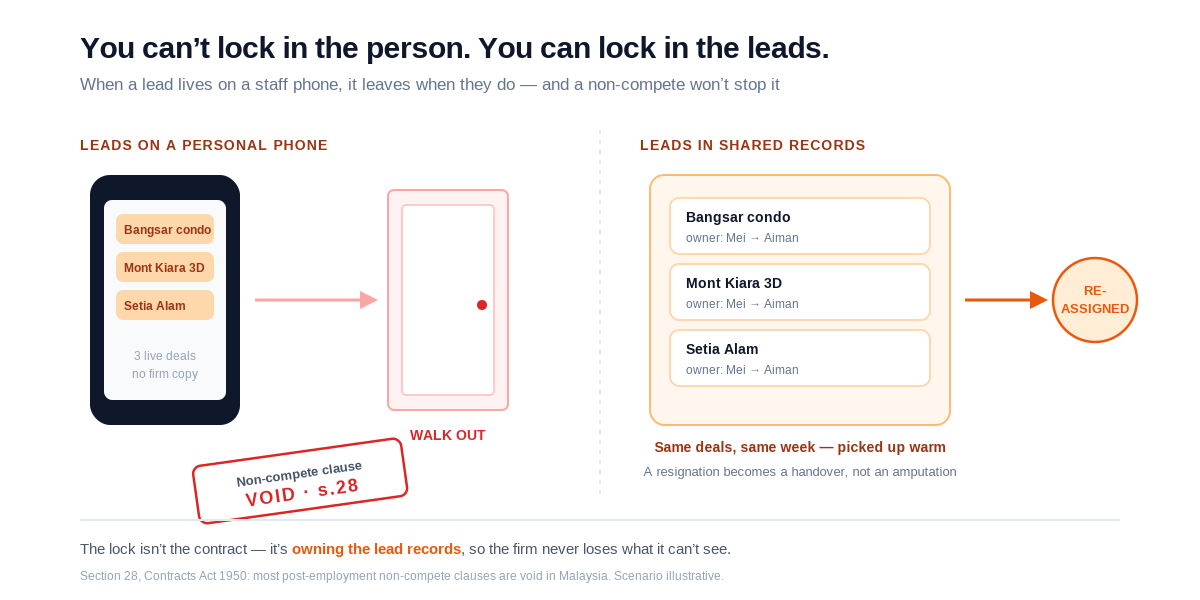
A KL interior-design studio owner told me about the Monday his most senior designer handed in her notice. Pleasant enough — a better offer, no drama. Then it hit him: her three best live projects, a RM120k Bangsar condo, a Mont Kiara unit at the 3D stage, and a Setia Alam job with a deposit paid, had only ever existed in her WhatsApp. The clients had her number. The quote revisions, the measurements, the "let me check with my husband" promises — all in a chat history on a phone that was about to walk out his door.
He asked her to forward everything. She forwarded some. Two of the three clients went quiet, then signed with her new firm within the month. He never even got a clean list of what had been in play.
If that makes your stomach drop a little, good — because this is the one lead leak that doesn't announce itself until it's already gone. And the instinct most owners reach for to prevent it, a tighter contract, is the one thing Malaysian law won't let them rely on.
What happens to your leads when a staff member leaves?
If your enquiries live on a staff member's personal WhatsApp, they leave when the person does. The live deals, the quote history, the half-made promises and the client's trust all sit in a chat thread the firm can't see — so a resignation doesn't just cost you a salesperson, it quietly drains the slice of your pipeline that person was holding.
It's worse than losing a cold lead, for three reasons:
- You lose the warmest deals, not the coldest. The leads a departing closer or designer holds are the ones furthest down the funnel — quoted, visited, deposit-adjacent. Those are the jobs you were about to win.
- You often can't even name them. Because nothing was captured centrally, there's no list. You find out a deal existed when you notice a competitor's photos of a project you almost did.
- The relationship is portable. The client has the staff member's number, not the firm's. When that person turns up at a new studio — or their own — the buyer follows the human they've been chatting with for weeks.
This is the mirror image of the repeat client who comes back for job two: there, loyalty flows to your firm because you hold the history. When the history walks out the door, so does the loyalty.
Can't I just make them sign a non-compete?
In Malaysia, mostly no — and this is the part owners get wrong. Under Section 28 of the Contracts Act 1950, every agreement that restrains someone from exercising a lawful profession, trade or business is, to that extent, void. Malaysian courts have consistently read this to mean that post-employment non-compete clauses are generally unenforceable (the leading authority is Nagadevan v Millenium Medicare Services [2011]). Unlike in the UK or Singapore, a Malaysian court won't weigh up whether your clause is "reasonable" and trim it to fit — the blanket rule strikes it down.
A non-solicitation clause — "you won't actively poach our clients for 12 months" — stands on slightly firmer ground and can sometimes be upheld if it's narrow and reasonable. But even then you'd have to prove an actual breach, and an ex-employee has no general bar on dealing with former customers who come to them. In practice that means a courtroom, evidence and months — while the deals close elsewhere.
The uncomfortable takeaway: you cannot legally own your people, and you can't forbid them from taking relationships you never captured. The only lock the law leaves you is the one you build yourself — owning the data. Which brings us to the real problem.
Why the leak starts long before the resignation letter
The deals don't walk out on resignation day — they were never in the building to begin with. By the time someone hands in notice, the damage was done months earlier, on day one of every lead, when the enquiry landed on a personal phone and no copy was ever made for the firm.
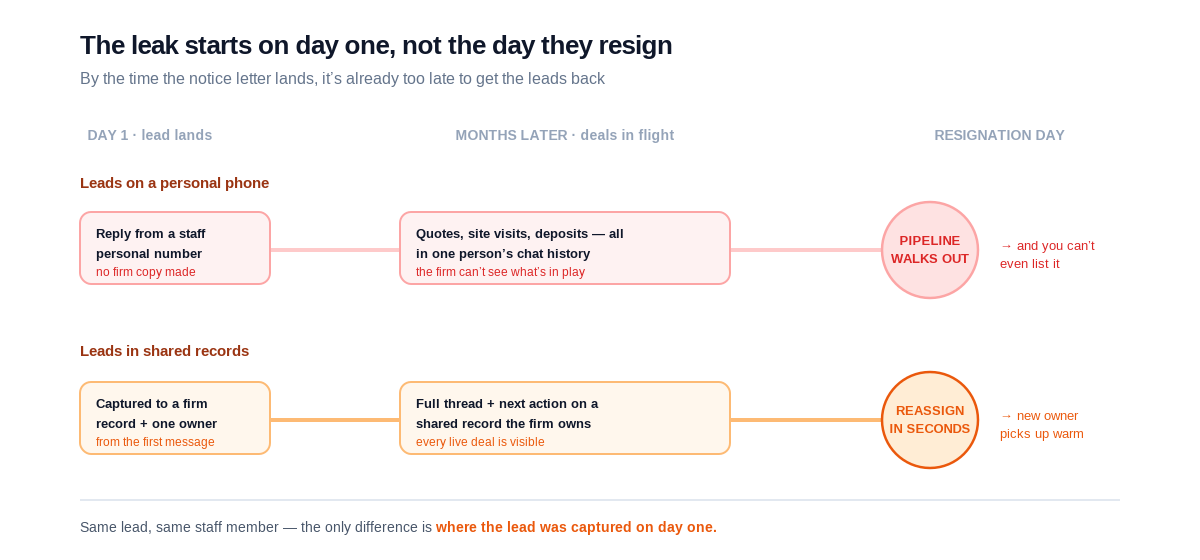
This is why "I'll just ask them to hand over properly before they go" rarely saves you. A departing employee — especially one leaving for a competitor or to go solo — has little incentive to hand over the warm deals cleanly, and often a genuine belief that they built the relationship, so it's theirs. You're relying on goodwill at the exact moment goodwill is lowest.
With Malaysian job mobility where it is — 35.2% of workers were planning to move in the first half of 2025 (Randstad/Kantar) — this isn't a rare catastrophe. It's a Tuesday. A firm that depends on nobody ever leaving is running on luck, and luck is not a lead-management system. The owner-operator who insists on holding every enquiry personally has the same disease from the other end: the whole pipeline lives in one head and one phone.
Personal-phone pipeline vs shared-record pipeline
Here's the same resignation, run two ways. The difference isn't how good your staff are — it's whether the firm could see the leads before the goodbye.
| When a key person leaves | Leads on a personal phone | Leads in shared records |
|---|---|---|
| Can you list their live deals | No — nothing was captured centrally | Yes — one filtered list, instantly |
| Who holds the client relationship | The employee (their number) | The firm (one shared thread) |
| The handover | "Please forward me the chats" — partial, if at all | Reassign every lead to a new owner in seconds |
| What the buyer experiences | A stranger starting cold, or follows the ex-staff | A new owner who picks up warm, same week |
| Your legal protection | A non-compete that's likely void (s.28) | You don't need one — you kept the data |
| Cost of the departure | A silent slice of pipeline, gone | A day of reassignment, nothing lost |
How do you make a resignation a handover, not an amputation?
You can only hand over what you can see — so the fix is almost entirely about where the lead lives from the first message, not about what you do on the last day. Five moves:
- Capture every enquiry into a record the firm owns — on day one. Not a personal phone, not one person's memory. The moment a lead replies, it should exist somewhere the business controls, with the channel, the scope and the history attached. This single habit defuses the whole problem.
- Put one named owner on every lead, by a rule you can change. Ownership should be an assignment the firm makes, not a relationship the employee privately owns. If ownership is a setting, you can move it; if it's a phone number the client saved, you can't. (This is the same one-owner rule that stops leads dying in the group chat.)
- Keep the full thread and the next action on the shared record. A handover is only clean if the new owner can read what was said, what was quoted, and what was promised. "Follow up after her loan clears" has to live on the lead, not in the departing person's head.
- On the last day, reassign a named list — don't reconstruct from memory. Pull up every live deal that person held, assign each to whoever's taking over, and have the new owner send a warm, human message that week: "Hi, I'm Aiman from the studio, I'll be looking after your Bangsar project with Mei — I've got everything, nothing to repeat." Continuity the buyer can feel is what keeps them.
- Watch what each person is holding, before they ever resign. If you can see each team member's open pipeline on an ordinary Tuesday, a departure holds no nasty surprises — you already know exactly what needs reassigning, and nothing was ever invisible.
How HotLead keeps the leads yours
HotLead sits as a light layer on top of the WhatsApp your customers already use — so leads stay on the channel Malaysians actually message on, but the record belongs to your firm, not to whoever happened to reply. Every enquiry is captured into one shared inbox the business owns, with its source, thread and history attached — so a lead was never trapped on a personal phone in the first place.
Lead routing puts one named owner on each lead by a rule you control, and lets you reassign any lead in a tap — so a resignation becomes a filtered list you hand to a new owner in minutes, not a scramble. Next-action dates keep each deal's promised follow-up on the lead itself, so the person taking over picks up warm instead of cold. And the team view shows what every person is holding before anyone leaves, so your pipeline is never a mystery living on someone else's device.
To be straight about it: HotLead can't stop a good designer taking a better offer, and it won't enforce a contract for you. What it does is make the thing a contract can't protect in Malaysia — the leads and the history — the firm's asset instead of the employee's.
This is one piece of a bigger system. Start with the renovation lead-management hub or, for interior-design studios, the interior-design hub; see what a dropped deal actually costs in the true cost of a lost renovation lead; and for a smoother handover when a lead changes hands, read how to catch up on a lead you've just inherited. The full picture is in the complete guide to managing renovation leads in Malaysia.
Sources: Restraint-of-trade position from Thomas Philip Advocates & Solicitors — Restraint of Trade Clauses in Employment Contracts in Malaysia and Low & Partners — Contracts in Restraint of Trade in Malaysia (Section 28, Contracts Act 1950; post-employment non-competes generally void; Nagadevan v Millenium Medicare Services [2011]); non-solicitation treatment from Donovan & Ho — Hands Off My Customers; proposed reform from Baker McKenzie — Malaysia: Proposed amendment to Section 28 of the Contracts Act 1950. Job-mobility figure (35.2% of Malaysian workers planning to switch jobs in H1 2025, Randstad Employer Brand Research / Kantar) via People Matters. WhatsApp penetration from DataReportal — Digital 2025: Malaysia. This article is general information on lead operations, not legal advice — get your own advice on your employment contracts. Named scenarios are illustrative; the pattern is one we see repeatedly.
Frequently asked questions
Can I stop an ex-employee from taking my renovation clients in Malaysia?
Mostly no. Section 28 of the Contracts Act 1950 makes post-employment non-compete clauses generally void. A narrowly drafted non-solicitation clause can sometimes be upheld, but you would have to prove an actual breach and show the restriction is reasonable — slow, costly and uncertain. The realistic protection is operational, not legal — own the lead records so a departure is a reassignment, not a loss.
What actually happens to leads when a salesperson resigns?
If the enquiries lived on their personal WhatsApp, the live deals, the quote history and the client relationships leave with them. The firm often can't even produce a list of which deals were in flight. Warm buyers get re-contacted cold by a stranger, or get closed by the ex-staff under a new name.
How do I hand over a departing employee's renovation leads cleanly?
You can only hand over what you can see. Keep every lead on a shared record with its owner, status, full thread and next action — then on the last day you reassign a named list of live deals to someone who can message each buyer warmly that same week, instead of reconstructing the pipeline from memory.
Should my sales and design staff use their personal phones for client WhatsApp?
It's convenient and it's how most small reno firms start, but it quietly makes every relationship the employee's asset instead of the firm's. The fix isn't banning WhatsApp — Malaysian buyers live on it — it's funnelling those chats into a shared record the business owns, so the conversation stays even when the person goes.
Keep reading
- Can AI Reply to Your Renovation Firm's 1-Star Review? I Built It — and the Risk Is How Fast It ApologisesA 2-star review on Google or Qanvast is the first thing your next renovation lead reads — and most firms either ignore it or fire back and make it worse. The 2026 reflex is to let AI write the reply. I built it, and drafting a calm response costs a fraction of a sen. But an AI tuned to be helpful apologises too fast — it will concede a fault in writing, promise a refund that never happened, and grovel to a fake review from a competitor. Here's the build that protects your rank instead of torching it.
- Which Lead Signals Actually Predict a Sale? Reverse-Audit Your Own Won JobsMost firms grade a renovation lead on signals that feel predictive — enthusiasm, a long message, a fast reply — and never check whether those signals actually separate won jobs from lost ones. Here is how to run a reverse-audit on your own closed deals, which signals usually survive it, and why your pipeline is too small to pretend the score is more than directional.
- The "I Only Deal With the Boss" Lead: When the Buyer Refuses Your TeamYou finally hired someone to share the load — then the buyer messages "can I deal with you direct ah, boss?" and refuses to engage your staff. Every big lead quietly re-centralises onto the one person already maxed out, and your firm can never grow past the owner. Here's why caving caps you, why a flat "my staff will assist" loses a nervous buyer, and the move that keeps both.