

A PJ interior-design studio owner told me about the Bangsar client she nearly lost while she was standing in her kampung in Kelantan.
Her senior designer, who owned the lead, had gone balik kampung for the two weeks over Raya. Right in the middle of that, the client — a warm one, quoted RM68k for a condo refit, keen on signing after her loan cleared — messaged: "hi, any update on my quote? ready to move now." A junior picked it up. He scrolled a bit, didn't want to keep her waiting, and replied with a fresh quote and a polite "let me confirm the final number for you." The client wrote back, cooler now: "I thought we already agreed 68 and you were including the feature wall?"
They had. It was there in the thread — a message from three weeks earlier, right after the site visit. Buried under forty other messages, the junior never saw it, and the firm spent the next two days climbing back down from a price it had already won, on a lead that had been ready to sign.
That gap — a warm lead, a person picking it up cold, a promise lost in the scroll — is one of the quietest leaks in a renovation business. So the obvious 2026 question is: can't AI just catch me up on this buyer? Short answer — yes, and it's one of the best things AI does in this whole process. But the reflex version drops exactly the thing that lost this deal. Here's the experiment.
Why does a renovation lead need "catching up" on at all?
Because a renovation lead is almost never one clean sitting — it's a stop-start relationship stretched over weeks, and the person who has to act on it next is often not the person who lived through it.
Two things make this structural, not sloppy. First, the buyer's clock is long and full of gaps. A serious reno decision waits on a home loan (weeks of processing), on collecting keys at vacant possession, on a spouse or parents, on the festive freeze. Home-improvement sales cycles have stretched — one industry tracker put the typical cycle at roughly double what it was, from about 30 days to 60 — and in Malaysia a financed job runs longer still. So a lead goes quiet for six weeks not because it's dead but because the buyer is genuinely waiting, and when it wakes, whoever answers has to remember a conversation from over a month ago.
Second, the person who owned it often isn't there when it wakes. About 76.5% of Malaysian SMEs are micro-enterprises with fewer than five staff, so there's rarely a bench — the one person who knew the deal is on a site, on leave, or has left the firm. Add the very Malaysian reality of the two-week Raya or CNY balik kampung exodus, and a warm lead resurfacing mid-festive lands on whoever's around. This is the owner-operator bottleneck showing up at the handover: the context lives in one head, and the moment that head is unavailable, the next person is reconstructing it from scratch.
That reconstruction is not free. Salespeople already spend only about 30% of their time actually selling, per Salesforce's sales research; the rest goes to admin, data entry and piecing information together. Knowledge workers more broadly lose close to two hours a day just searching for and gathering information, by McKinsey's estimate. Scrolling forty messages to work out what was quoted and promised is that tax, paid one warm lead at a time — and worse than the time is the risk of getting it wrong in front of a buyer who's ready to sign.
So what happened when I asked AI to "catch me up on this buyer"?
The summarising itself was genuinely good — which, as with every dangerous build in this series, is exactly what makes the reflex version risky.
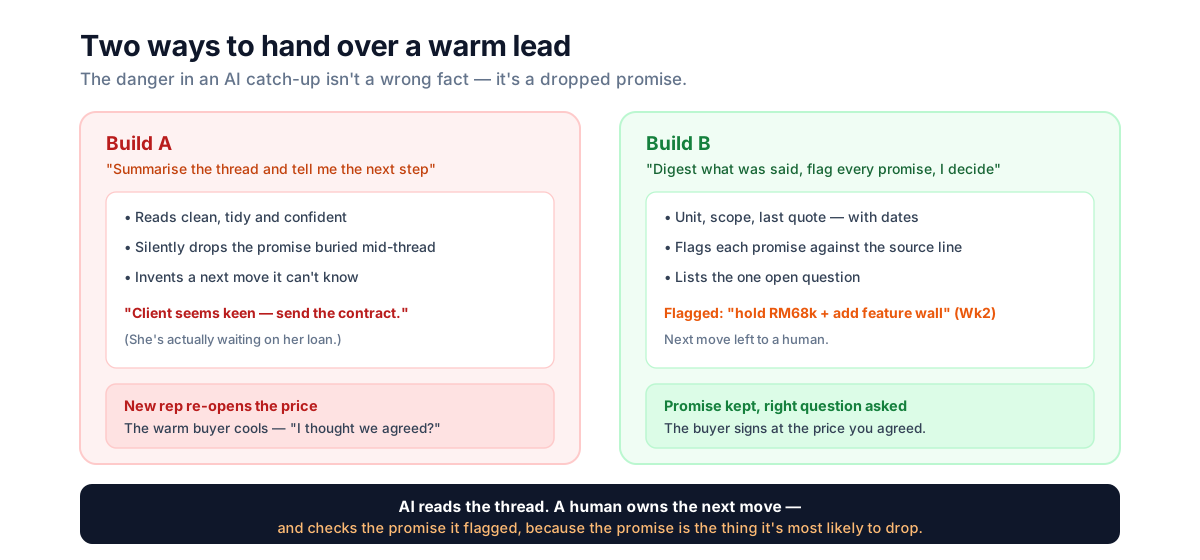
I fed a model a long, realistic reno thread — the messy kind, English and Malay mixed, voice-note transcripts, a couple of photos referenced, a quote sent, then weeks of gaps — and asked the obvious thing: "Summarise this conversation and tell me what to do next." It came back with a tidy paragraph: who the buyer was, the unit, the rough scope, that a quote had gone out, and a confident closing line — "The client seems keen and ready to proceed; recommend sending the contract to close."
It reads great. It's also two different kinds of wrong, and the second kind is the one that costs you a job.
Why is "tell me the next step" the wrong thing to ask?
Because the next step depends on facts that were never in the chat, so asking AI to supply it forces a guess dressed as a recommendation.
"Send the contract to close" sounds decisive. But whether that's right depends on things the thread doesn't contain: is her home loan actually approved yet (she said weeks ago she was "waiting for bank"), is your crew free the month she wants to start, and is this even still live or has she gone with someone else and is just being polite? None of that is written down. The model doesn't know it's missing — it fills the gap with the most plausible-sounding move, and plausible is not the same as correct.
This is the one-question test that runs through this whole series, applied to a handover: does deciding this need a fact that isn't in the chat? Summarising what was said — the whole point of a catch-up — passes, because it's all in the thread. Deciding the next move fails, because the deciding fact lives off-channel: in the bank's queue, in your crew's week, in the buyer's head. Let AI hand over a clean picture of the past; keep the decision about the future with the human who can find those facts.
The dangerous part isn't a wrong fact — it's a dropped promise
Here's the failure that actually loses jobs, and it's subtler than a hallucinated number: a good-looking summary that quietly leaves out the one commitment the whole deal rests on.
Go back to the Bangsar client. The load-bearing fact in that thread was a single message: "ok no problem, we hold at 68 and include the feature wall, you take your time with the loan." Everything after — whether the firm looks trustworthy, whether the price is settled, whether the buyer signs — hinges on it. A summary that captures the unit, the scope and "a quote was sent" but omits that promise isn't 90% right. It's wrong in the one place that matters, because it reads as nothing was agreed — and the person acting on it will re-open a settled number, exactly as the junior did.
An omission is more dangerous than a bad fact for a simple reason: you can't catch what isn't there. A wrong price jumps out; a missing promise looks like a clean, complete summary. And a clean-reading digest gets more trust than the messy original thread, so you check it less — the same polish-hides-the-error trap that makes an AI-extracted supplier quote so risky to sign off. The tidier the catch-up, the more likely you are to act on it without opening the thread.
Why the promise is the exact thing that gets dropped
This isn't bad luck. There's a well-documented reason a language model is most likely to drop the commitment, and it comes down to where in the thread the commitment sits.
Researchers studying how models handle long inputs described a pattern they called "Lost in the Middle": a model recalls information near the beginning and the end of a long context reliably, but its accuracy on facts stuck in the middle degrades sharply — in their tests, by more than 30%. Retrieval over a long conversation follows a U-shape: strong at the edges, weak in the belly. (Newer long-context models are better at simple fact-finding, but the shape hasn't gone away for messy, real-world text — and a WhatsApp reno thread is about as messy as text gets.)
Now look at where a renovation promise lives. The enquiry is at the start (a summary keeps it). The buyer's latest "any update?" is at the end (a summary keeps it). But the deal-making commitment — hold the price, include the feature wall, we'll start after your keys — is made in the middle: after the site visit, once trust is built, and before the long silence on the loan. That's the dip in the U. The single most important sentence in the thread sits in the exact position the model is least reliable at recalling.
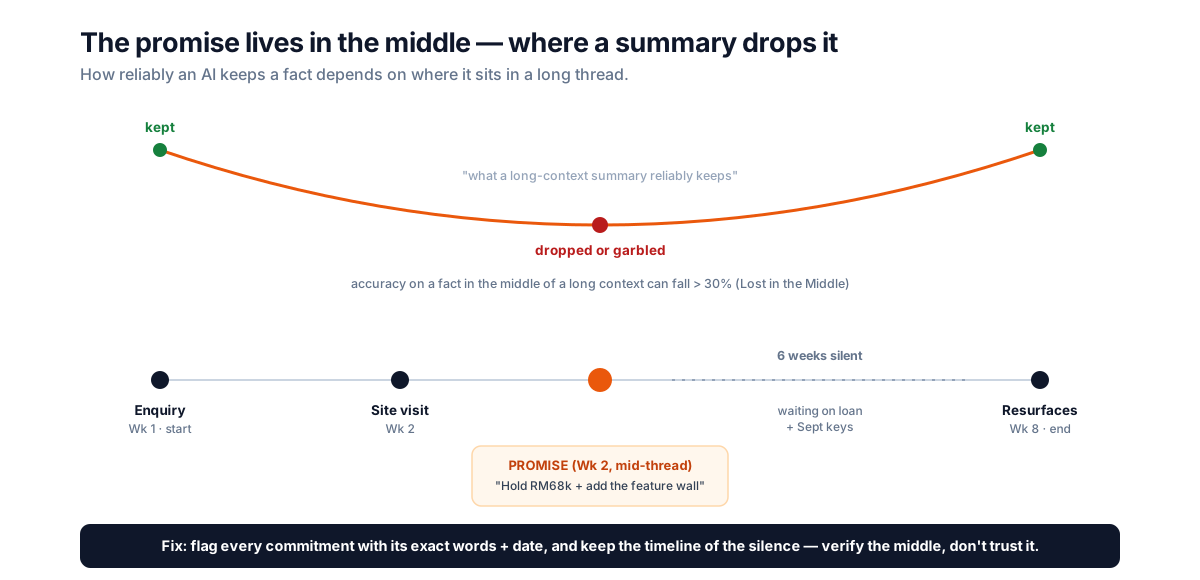
So "the AI dropped the promise" isn't a fluke you can prompt away with "be more thorough." It's a structural weakness pointed straight at your most valuable sentence. Which tells you exactly how to build the thing safely.
What did the build that actually paid look like?
The one that works flips the job from narrate and advise to extract, flag, and hand over. Same division of labour that's earned its keep at every step of this chain: AI reads and organises, the human owns anything you can't cleanly undo.
Build B does four things and stops:
- Digests only what was actually said, into fixed fields: buyer and unit, scope, the last quote and its date, timeline, and the current open question. No narration, no "seems keen."
- Flags every commitment against its source line. Any "we'll hold," "we'll include," "we agreed," "I promised" is pulled out and shown with the exact words and the date — so verifying it is a two-second glance at the quoted line, not a re-scroll of forty messages. Because the promise is the thing most likely to be dropped, the promise is what gets the brightest flag.
- Keeps the timeline of the silence as a first-class fact — not just "buyer went quiet" but "quiet since 14 July, last message said 'after I collect keys in Sept.'" (More on why that line matters below.)
- Lists the open question and stops. It never proposes the next move. The human reads the catch-up in thirty seconds, checks the flagged promises, and decides.
| Build A — "summarise + next step" | Build B — "digest, flag, I decide" | |
|---|---|---|
| What AI produces | A tidy paragraph + a recommended move | Fixed fields + flagged commitments + open question |
| The promise | Can silently drop it (mid-thread) | Flagged with exact words + date |
| The next move | Invented from off-channel guesses | Left to a human |
| How you verify | Re-read the thread to be sure | Glance at the quoted source line |
| Wrong-call cost | Re-open a won price, look like you forgot | A two-second check |
The flags and the timeline are the product — not the tidy paragraph. A catch-up you can trust without opening the thread isn't the goal; a catch-up that shows you exactly which three things to verify, and where, is.
The fact a "summarise this chat" prompt drops first: the gap itself
Here's the second insight that a generic summariser misses, and it's specific to how renovation leads behave: in a reno thread, the silence is data.
A generic "summarise this conversation" prompt condenses the words. But a reno lead's most important signal is often the shape of the quiet — because a reno stall is dated, not dead. "Quiet six weeks, last message 'after I collect keys in Sept'" is a warm lead on a wake-date you should be ready for. "Quiet six weeks, no reason given" is a cold lead to gently test. Same length of silence — completely different next move. Strip the timeline out of the digest, as a words-only summary does, and you hand the new person the one thing guaranteed to make them misjudge it: a warm held lead that looks abandoned, or an abandoned lead that looks warm.
This is why Build B treats the last-contact date and any dated reason as fields in their own right, not flavour text. The stall-detection build leans on the same distinction — dated silence is marinating, undated-past-your-median silence is stalling — and a handover digest that loses it hands the next person a coin toss.
What should an owner actually do?
You don't need an AI summariser to fix most of this. The biggest wins are in how you hold the lead, not how you compress it — and they make any future AI catch-up safer too.
- Keep the whole conversation on one record, not three phones. The reason a handover is painful is that the history is scattered — some on the owner's WhatsApp, some in a group chat, some in someone's memory. One record per lead, with every message and quote, is what makes a catch-up — human or AI — possible at all.
- Give every lead one owner by rule, so a handover is deliberate. A lead lost in the group chat with no owner has no clean handover because it had no clear holder. When the owner goes on leave, reassign it on purpose — don't let it drift.
- Write the promise down where the next person will see it. The single highest-value habit: the moment you say "we'll hold 68 and include the feature wall," put it on the record as a note or the next action — not only in the flow of chat where it'll sink into the middle. You're pre-empting the exact failure the AI has.
- Keep the wake-date, not just the note. "Follow up after her keys in Sept" as a dated next action means the lead resurfaces to you on time, and whoever holds it knows why it was quiet.
- If you do use AI to catch up, ask for "what was said," never "what to do" — and always eyeball the flagged promises. Make it extract and flag; keep the decision yours.
How HotLead fits — honestly
I'll be straight, the way I try to be in every one of these. HotLead does not ship an AI that reads your thread and writes you a catch-up summary — that's the experiment in this piece, and the point of the piece is that the safe version flags promises and stops short of deciding. What HotLead gives you is the groundwork that makes a handover survivable without a summariser, and that would make any future AI catch-up trustworthy:
- Every message, photo and quote on one record. The whole history lives in one place a human can actually read, instead of being scattered across phones and a group chat — the thing that makes reconstruction possible at all.
- One owner per lead, by rule. Round-robin, manual, or a custom rule by area or source, so a lead always has a clear holder and a handover is a deliberate reassignment — not a warm lead drifting between people while one of them is balik kampung.
- A next action and an overdue nudge, so "hold the price, follow up after her keys in Sept" is a tracked, dated step that resurfaces on time — the promise and the wake-date written down where the next person sees them, not buried in the middle of a chat.
- A team-performance view, so you can see who picks up handed-over and resurfaced leads and turns them into signed jobs, and who lets them fade.
The reading, AI can genuinely help with one day. The record and the ownership are what stop the lead from dying in the gap today. If that gap is the problem underneath this, start with the complete guide to managing renovation leads in Malaysia, see how it fits a renovation firm or an interior-design studio, and read the companion builds on what AI still can't do, updating the CRM after every chat, and which of these AI builds actually paid.
Sources: That salespeople spend only about 30% of their time actively selling — with the rest going to admin, data entry and information-gathering — from Salesforce's State of Sales research. That knowledge workers spend roughly 1.8 hours a day (about 9.3 hours a week) searching for and gathering information, from the widely cited McKinsey estimate on information-retrieval time. The "Lost in the Middle" finding — that language models recall information at the start and end of a long context reliably but their accuracy on information in the middle can degrade by more than 30%, following a U-shaped curve — from Liu et al., "Lost in the Middle: How Language Models Use Long Contexts"; that current state-of-the-art models still hallucinate a measurable share of the time even when summarising short documents (and more on longer, complex text) is tracked by Vectara's hallucination leaderboard. That home-improvement sales cycles have lengthened (roughly doubling toward ~60 days) is reused from the how-long-to-close piece, and the ~63%-won't-buy-within-three-months / dated-stall framing from the nurture piece. That about 76.5% of Malaysian SMEs are micro-enterprises with fewer than five staff is from DOSM's Economic Census, reused from the owner-operator-bottleneck piece. Renovation lead-volume (40–60 enquiries a month) and the ~RM1,280 expected gross profit per enquiry are typical operating figures reused from the cost-of-a-lost-lead and funnel-benchmarks pieces and labelled as typical; the catch-up experiment and the per-summary AI cost are described from practice and labelled illustrative, not a controlled trial or a quoted price.
Frequently asked questions
Can AI summarise a long WhatsApp lead thread so someone can take it over?
Yes, and this is one of the strongest uses of AI in the whole lead process — it's a read-only job where the input is fully in the chat, the output is reversible, and it saves real time. AI can condense a forty-message, multi-week thread into the unit, scope, last quote and date, what was promised, and the open question in seconds. Two rules make it safe. First, it must flag every commitment against the exact line it came from, because a promise buried in the middle of a long thread is the thing a summary is most likely to drop. Second, it must stop at "here's what was said" and leave the next move to a human, because deciding what to do next needs facts the chat doesn't hold.
What's the real risk in an AI catch-up summary?
Not an obviously wrong fact — you'd catch that. The risk is a confident omission. On a long thread, language models recall the beginning and the end well but drop or garble information in the middle — the documented "Lost in the Middle" effect, where accuracy on mid-context facts can fall over 30%. In a renovation thread the load-bearing promise ("we'll hold the price," "we agreed to include the feature wall") is usually made in the middle, after the site visit and before the buyer went quiet. A digest that omits it reads as if nothing was agreed, so whoever picks up the lead re-opens a settled price or misses a commitment — and to a warm buyer that reads as a firm that forgot, which is how you lose a deal you'd already won.
Should AI decide the next step from the summary?
No. Summarising what was said is a read job the chat fully supports. Deciding the next move needs facts that live off-channel — is her home loan approved yet, is your crew free the week she wants, is this genuinely still live or a polite soft-no? None of that is in the thread. This is the same one-question test that runs through this series — if answering needs a fact that isn't written in the chat, keep the judgment human. Let AI hand the new person a clean, flagged catch-up; let the person decide what to do with it.
How is this different from using AI to update my CRM after each chat?
They're neighbours but not the same job. Updating the CRM is structuring one conversation into fields and a stage as it happens — an ongoing, per-chat task. A catch-up digest is compressing one buyer's entire multi-week history into something a person taking it over cold can absorb in thirty seconds — a one-off, whole-thread task triggered by a handover or a resurfaced lead. The CRM-update piece warns against letting AI set the stage; this one warns against letting AI drop the promise or invent the next move. Different failure, same discipline — AI reads and organises, a human owns anything you can't cleanly undo.
Does HotLead automatically summarise my lead conversations?
No, and I won't pretend it does — the AI catch-up is the experiment in this piece, not a shipped feature. What HotLead does is make the handover safe without a summariser. Every message, photo and quote lands on one record, so the full history is in one place for a human to read instead of scattered across three phones and a group chat. Every lead has one owner by rule, so a handover is a deliberate reassignment, not a lead quietly falling between people. And a next action plus an overdue nudge means a resurfaced or handed-over lead is a tracked step, not a note in someone's head who's on leave. The reading AI can help with; the record and the ownership are what stop the lead from dying in the gap.
Keep reading
- The Only Three Ways to Grow a Renovation Firm — and Which Lever to Pull FirstEvery renovation firm's revenue comes down to three levers — how many leads you get, how many you close, and how big each job is. They multiply, so a modest lift on each compounds. But they cost wildly different amounts to pull, and most owners reach first for the one they should reach for last. Here's the ranking, with Malaysian numbers.
- Sight Unseen: Winning the Overseas Malaysian Who Renovates a Unit They Can't VisitA Malaysian working in Singapore collects the keys to a KL condo and messages you to fit it out — but they can't come to a site visit, can't walk your showroom, and will wire a deposit to a firm they've never met. Most firms treat this lead like a walk-in, go quiet when the buyer can't pop by, and lose the highest-budget job in the inbox. Here's why the remote buyer is your hardest-trust but best-paying lead, and how to build a remote lane that actually closes it.
- "Ok, Proceed" Isn't Money in the Bank — I Built an AI to Ask for the Deposit the Moment a Renovation Buyer Says YesA Cheras contractor closes a RM62k job on WhatsApp, the buyer says "ok proceed lah", and then the owner — mid-site, phone in a dusty hand — has to stop, pull the bank details, the agreed deposit and the scope, and type a careful money message. In that gap a hot yes quietly cools back to "let me think." The 2026 reflex is to ask AI to detect the yes and auto-fire the invoice. I built it, and it asked a half-committed buyer for 40% to a personal account two seconds after a soft "ok ok". Here's the version that kills the typing delay without asking for money off a misread.