

Here's a Tuesday that happens in every renovation and contractor firm in the country. A Johor Bahru aluminium-and-glass installer is up a ladder finishing a shopfront when his phone starts buzzing in his pocket. He can't answer — both hands are on the frame. By the time he's down, the call's gone. No voicemail. Just a JB mobile number he doesn't recognise, sitting in his missed-call list among six others. Was that a supplier, a wrong number, or the RM40k balcony job he's been hoping for? He'll never know, because that caller is already messaging the next installer on their list.
Every AI build in this series so far has read a WhatsApp text, a photo, or a file export. But a real slice of built-environment enquiries never touch text at all — they arrive as a phone call or a voicemail while the owner is on a site, driving, or in a meeting with a client. And a missed call with no record isn't a lead in the pipeline. It's just gone.
So the 2026 question an owner reaches for is obvious: can AI just transcribe the voicemail, create the lead record, and dial the buyer back for me? And the sharper one I always end up on: what happens the day the number is wrong? Because a spoken phone number over a noisy line is close to the single worst thing you can hand a speech-to-text model — and here, that one field is the whole ballgame. I built it and measured it. Here's the problem, what a missed call costs before AI, what the two builds did, and the version that actually held up.
What does a missed phone-call enquiry actually cost a renovation firm before any AI?
More than almost any other lost lead, because the phone caller is the highest-intent buyer you get. Someone who picks up the phone to a renovation firm isn't browsing — they've got a specific job and they want to talk now. That's why call-tracking research (BIA/Kelsey, widely cited across home-services marketing) puts phone leads at 10–15× the conversion of a web-form submission. When one of those goes to voicemail, you're not losing an average lead; you're losing the best kind.
And here's the brutal part: they don't wait for you. Around 80% of callers who reach a voicemail hang up without leaving a message, and of the few who do, most won't call back — home-services data reports that roughly two in three will immediately ring a competitor instead. Small firms miss a startling share of their inbound calls in the first place — one analysis puts it around 27% on average, and as high as 62% for small businesses during working hours, when the one or two people who answer are already on a site or on another call. The math is unforgiving: a high-intent buyer, a channel that punishes you for being 30 seconds late, and no record left behind.
Now put a number on it in our terms. A busy small reno or ID firm runs 40–60 enquiries a month across WhatsApp, Facebook, Qanvast — and the phone. At a ~7–8% close rate and roughly RM1,280 of expected gross profit per winnable enquiry, every handful of missed calls that vanish without a trace is a real four-figure hole in the month. This is a WhatsApp-first market — but "first" isn't "only," and the calls that still come in land on exactly the people least able to answer them.
So can AI just transcribe the voicemail and dial back? The reflex build — and the one field it can't afford to get wrong
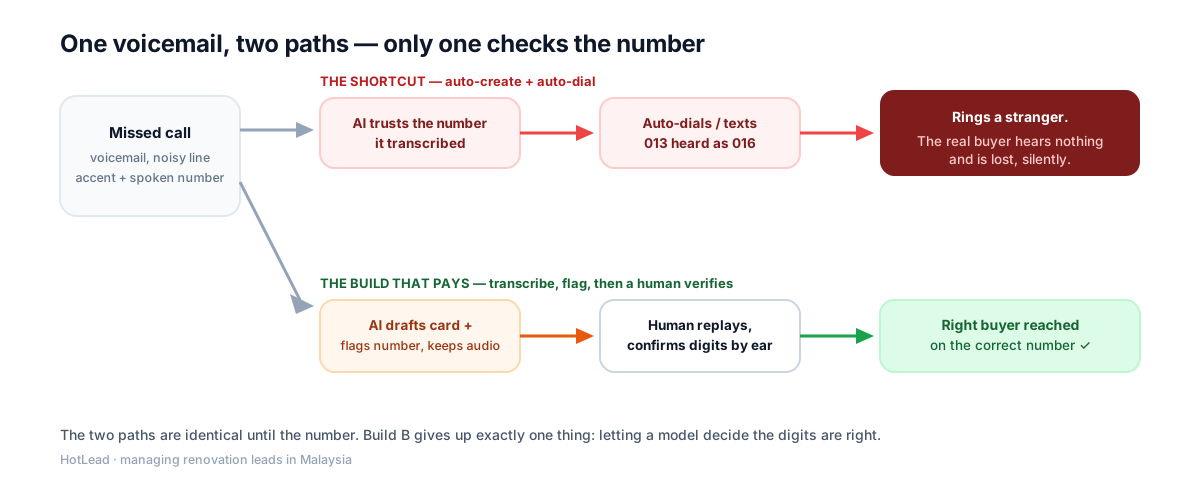
This was Build A, and like every reflex build it demos beautifully: a voicemail lands, AI transcribes it, pulls out the name, phone number, area, scope and budget signal, auto-creates a lead card, and — the tempting step — auto-dials or auto-texts the number it heard, so the callback happens before the owner is even off the ladder. On a clean voicemail from a clear speaker it looks like magic. Then you run it against a real Malaysian site line, and it breaks on the one field that matters most.
The two fields you most need are the two speech-to-text is worst at. The best engines today sit around a 4–5% word error rate on clean audio, but that number is measured on tidy recordings — and it climbs sharply on accented speech, background noise and telephone-quality audio. Worse, the errors don't fall evenly. Common words get transcribed fine; the tokens that fail are the short, unique, out-of-vocabulary ones — proper names and numbers. AssemblyAI's own accuracy write-ups call this out directly: names of people and places routinely misfire, and disambiguating "fifteen" from "fifty" — or "thirteen" from "thirty" — needs context a model doesn't always have. There's a whole line of ASR research (Zhang et al., "Improving Proper Noun Recognition") devoted to just this failure. A caller's name and phone number are nothing but proper nouns and digits — the model's two weakest spots, delivered together.
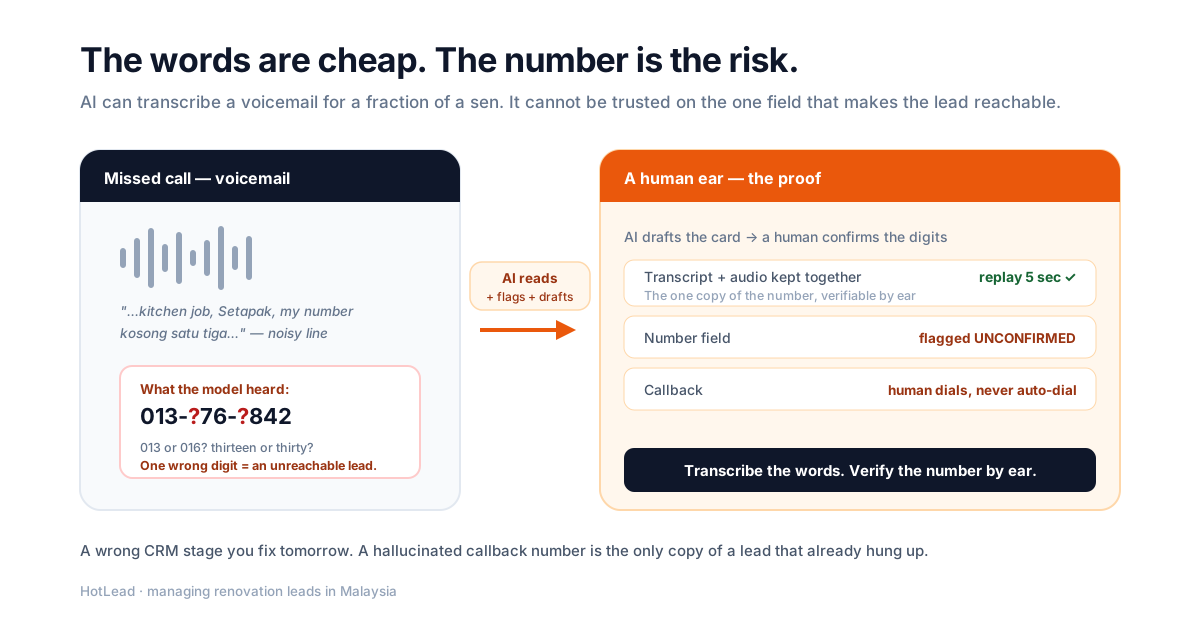
Now add the Malaysian reality. The voicemail is a stranger's accent — maybe a mother-tongue speaker whose accent the model saw little of in training — reciting a 10-digit 01X mobile number in Manglish over a noisy line, half-swallowed, sometimes read as "kosong satu tiga…" mixing Malay and English digits. This is the worst case for the technology, aimed squarely at the field you cannot fudge. One misheard digit — 013 for 030, thirteen for thirty in the sequence — and the whole record is poisoned.
And a wrong number here is unrecoverable — that's what makes this step unique. Think about how it differs from everything else in the chain. If AI mis-sets a CRM stage, you fix it from the same chat tomorrow. If it mis-reads a budget in an enquiry, the buyer is still on WhatsApp to clarify. But a caller who left a voicemail has already hung up. There is no second copy of the number, no thread to scroll back to. If the transcribed digits are wrong, you have no way on earth to reach them — and if Build A auto-dials that hallucinated number, you cheerfully call a stranger while the real buyer, who was ready to hire you, hears nothing and moves on.
Where does AI genuinely earn its keep on a missed call?
On everything except trusting the number — and that's still most of the tedious work. The mistake is asking AI to be the one who says "this is the buyer, at this number, call them." The right job is to make a human's callback fast, structured and impossible to forget. Here's the safe half, and it's real:
- Transcribe verbatim and structure the enquiry. Turn the voicemail into readable text and lay out the scope, area and budget signal as a draft lead card — so the owner isn't replaying a message three times while balancing on a ladder. For a fraction of a sen.
- Flag the number and every figure as unconfirmed. Mark the phone number, the budget, any measurement the caller said as "heard, not verified" — with the original audio kept attached to the record. The point isn't to hide the guess; it's to label it as a guess and keep the source to check it against.
- Draft the callback, don't make it. Prepare the "Hi, returning your call about the balcony glazing — when's a good time to visit?" opener for the owner to send after they've confirmed who they're reaching. Never auto-dial, never auto-text a transcribed number.
- Surface it into the next-action list, oldest first. Push "missed call — verify number, call back" as a live task with the audio and the draft attached, so the highest-intent lead you get can't sit unseen in a missed-call list while the crew's on a roof.
That's the same division of labour that's held up at every step of this chain: AI does the reading and the drafting, the human owns the irreversible act. When AI reads a payment slip it drafts the acknowledgement but a person confirms the money; when it drafts the on-site scope from voice notes it structures the record but the estimator confirms the measurements; here it structures the enquiry but a person confirms the number that makes the lead reachable at all. The rule the whole series keeps landing on — give the human the verdict that can't be undone — is at its sharpest when the un-undoable thing is whether you can even phone the buyer back.
Build A vs Build B — the honest comparison
| At the missed-call step | Build A — AI transcribes & auto-dials | Build B — AI transcribes, flags & drafts; human verifies |
|---|---|---|
| Transcribing the words | Fast, cheap | Fast, cheap |
| Structuring into a lead card | Automatic | Automatic (draft) |
| The caller's phone number | Trusted as transcribed | Flagged unconfirmed, audio kept |
| Making the callback | Auto-dials / auto-texts the number | Human confirms digits by ear, then calls |
| If a digit was misheard | Rings a stranger; real buyer lost silently | Caught on playback before any call |
| Against a noisy line / strong accent | Fails exactly where it's least reliable | Human is the safety net where AI is weakest |
| Cost of one error | An unreachable lost lead, unnoticed | 20 seconds of a human's attention |
The two builds are identical right up to the number. Everything AI is genuinely good at — transcribing, structuring, drafting, surfacing — Build B keeps. It gives up exactly one thing: letting the model decide the digits are right. That single line is the difference between a tool that saves you a minute of typing and a tool that, on its worst day, phones a wrong number while the RM40k job you missed goes to the next installer.
What should an owner actually do about missed calls?
Fix the plumbing first, then let AI be the safety net — not the mechanism. Most of the win here isn't model cleverness; it's making sure fewer high-intent buyers ever have to leave a voicemail in the first place.
- Turn voice into text at the source. The single best missed-call system is one that produces fewer missed calls. A WhatsApp business line with an instant auto-greeting means most buyers message instead of ring — and a typed number is a real, exact record, not a guess off a compressed audio file. AI reads text far more reliably than a noisy call, so move the channel before you try to rescue it.
- When a call does slip, transcribe-to-draft, never transcribe-to-dial. Use AI to build the draft lead card and the callback message. Keep the act of reaching the buyer human, every time.
- Keep the audio and verify the number by ear. Any transcribed digit is a draft. Ten seconds of playback before you save the contact is the whole defence — and it only works if the recording stays attached to the lead.
- Give the callback one named owner. A missed call that's "someone should ring them back" is nobody's job. One person owns returning it, the same reason every lead needs a single owner.
- Make the un-returned call overdue-able. A missed high-intent call should nag like any overdue follow-up until someone's actually spoken to the buyer — because with an 80% no-voicemail rate, speed back is the whole game.
How HotLead fits — honestly
I'll be straight, the way I try to be in every one of these, because over-claiming is exactly the hype I keep arguing against. HotLead does not ship a voicemail transcriber or an AI call-capture feature — the transcribe-and-flag build is the experiment in this piece, not a product page. And the honest conclusion of the experiment is that the reliable fix for a missed call is to move the buyer onto text, where the number captures itself, rather than to lean on a model to read digits off a noisy line. What HotLead gives you is the plumbing around that:
- Capture every WhatsApp and web enquiry into one clean record, so the channels where the number is exact and typed — not guessed — never leak in the first place. That's the channel you want your high-intent buyers on.
- One owner per lead, by rule. Round-robin, manual, or a custom rule by area or source — so a callback that needs making has a named human accountable for it, not a shared missed-call list where everyone assumes someone else rang back.
- A next action and overdue flag on every lead, so "missed call — call back" is a live, nagging task, not a number lost among six others while the owner's on a site.
- A per-channel funnel and team performance view, so you can actually see how much of your pipeline still comes by phone, whether those callbacks are happening, and which rep is letting them cool — the leak this whole piece is about, made visible.
Whether the transcribed number is right stays with a human and their ear, where it belongs. If leaking, scattered, un-returned leads are the problem underneath all this, start with the complete guide to managing renovation leads in Malaysia, see how it fits a renovation firm or a construction and contracting outfit, or read the companion builds on reading site voice notes into a scope record and what AI still can't do in a contractor's lead process.
Sources: Phone-lead value — that phone leads convert at roughly 10–15× a web-form lead, sourced to BIA/Kelsey and widely cited in home-services marketing research — from Invoca's home-services statistics roundup. Missed-call and voicemail behaviour — that around 80% of callers hang up without leaving a voicemail, that most who reach voicemail won't call back and roughly two-thirds immediately ring a competitor, and that small businesses miss on the order of 27% of inbound calls on average and up to ~62% during working hours — from ContractorInCharge's missed-call statistics for home-service companies and Aira's missed-business-call data. Speech-to-text accuracy — that best-case word error rate sits around 4–5% on clean audio but rises sharply on accented, noisy and telephone-quality speech, and that numbers, names and other short unique tokens are the hardest to transcribe (the "fifteen vs fifty" and proper-noun failure modes) — from AssemblyAI's speech-to-text accuracy guide and the proper-noun ASR research of Zhang et al., 2020. Renovation operating figures — 40–60 enquiries a month across channels, a ~7–8% close rate, and ~RM1,280 of expected gross profit per winnable enquiry — are the house figures used across this series (see the funnel-benchmarks and pillar pieces), labelled as typical operating numbers rather than a single quoted study. The ~90.7% WhatsApp-for-business figure is reused from earlier pieces. The per-call AI transcription cost is described from practice and labelled illustrative, not a controlled trial or a quoted price. All money figures in this article are illustrative — measure your own to know what a missed call really costs you.
Frequently asked questions
Can AI transcribe a voicemail into a renovation lead record?
Yes, cheaply and quickly, for the words. It can turn a spoken enquiry into a draft lead card with the scope, area and budget signal laid out. What it cannot do reliably is capture the two fields that make the lead usable — the caller's phone number and the spelling of their name — because digits and proper names are exactly where speech-to-text fails most, and worse over a noisy line or a strong accent. So AI should draft the record and flag the number as unconfirmed, not create-and-dial it automatically.
Why is a wrong phone number worse than other AI errors in the lead process?
Because it is unrecoverable. If AI mis-sets a CRM stage or mis-reads a budget, you can correct it later from the same chat. But a caller who left a voicemail has already hung up — if the transcribed number is off by one digit, you have no way to reach them and no second copy of the number to check against. Every other step in the chain leaves the source sitting on WhatsApp; a missed call leaves only the audio, which is exactly why the number has to be verified by ear before you trust it.
Should a renovation firm let AI auto-dial or auto-reply to a transcribed call?
No. Auto-dialling a number speech-to-text guessed means you might call a stranger while the real buyer hears nothing back, and an auto-text to a mis-transcribed number goes to the wrong person entirely. The safe build has AI surface the transcribed enquiry into a next-action task with the audio attached, so a human plays the last few seconds, confirms the digits, and then makes the callback. The AI saves the typing and the triage; the human owns the one irreversible action — reaching the right person.
How accurate is speech-to-text on Malaysian accents and phone numbers?
On clean, clear speech, the best engines sit around a 4-5% word error rate, but that rises sharply on accented speech, background noise and telephone-quality audio — and numbers, names and other short unique tokens are the hardest of all. A spoken Malaysian mobile number over a busy site line, in Manglish or a mother-tongue accent the model saw little of in training, is close to the worst case for the technology. Treat any transcribed digit as a draft to verify, never a fact.
Does HotLead transcribe calls or capture voicemails with AI?
No — HotLead does not ship a voicemail transcriber or a call-capture feature, and this experiment is part of why. The reliable answer to a missed call is to move buyers onto text, where the number captures itself. What HotLead does is the plumbing around that — capture every WhatsApp and web enquiry into one clean record, one named owner per lead so a callback is somebody's job, a next action and overdue flag so an un-returned call can't sit for a week, and a per-channel funnel so you can see how much of your pipeline the phone still carries.
Keep reading
- Did We Already Say RM68k? Using AI to Stop Quote Drift Across a Long Renovation ThreadOver a weeks-long WhatsApp thread with two or three quote revisions, a rep re-states a number that contradicts an earlier promise — and re-opening a settled price quietly invites a discount that eats a whole job's profit. So I pointed AI at the drift. It works beautifully as a flag, and dangerously as an auto-corrector.
- The Warranty as a Closing Lever: Why a Longer Guarantee Beats a Discount on a Renovation DealA quote is stalling and the buyer wants a reason to say yes. Before you drop the price, look at the other lever in your hand — a longer workmanship warranty. It is the same expected-value decision as a discount, but the math runs the opposite way — a price cut costs you thousands with certainty, while extending the defects cover costs you a couple of hundred ringgit in expectation, for arguably more trust with a scam-wary buyer. Here is the EV case for the non-price concession, the trap that turns it into a hidden liability, and which leads it actually moves.
- "Can You Just Build It, My Neighbour Also Did" — Handling the Renovation Lead That Needs Council Approval FirstSome renovation enquiries can't legally start next month, no matter how ready the buyer is — a kitchen extension, a hacked-through wall, a roofed-over air well all need the council's written approval first. Quote a fast build price to win the job and you either lose it to a "boss, can start" cowboy, or win it and inherit the stop-work order, the RM50,000 fine and a client who later can't sell the house. Here's how to spot the permit-first lead and sell the approval as protection.