

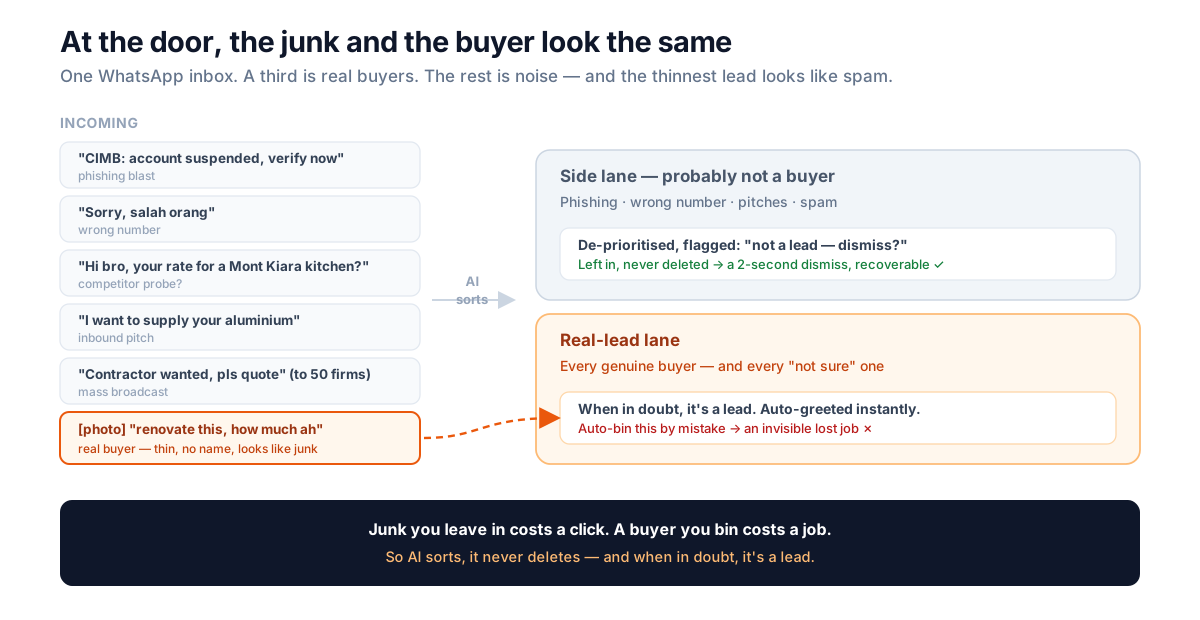
A contractor in Cheras sent me a screenshot of his WhatsApp last month and asked, half-joking, whether I could "make the rubbish go away." It was a normal Tuesday for him: forty-odd unread chats, and maybe a third were actual buyers. The rest was a fake CIMB "account suspended" blast, two "sorry salah orang" wrong numbers, an aluminium supplier pitching to be his vendor, a "contractor wanted for condo repaint, please quote" broadcast clearly forwarded to half of Klang Valley, and — his favourite — a suspiciously specific "hi bro, what's your rate for a full kitchen in Mont Kiara?" from a number he was fairly sure belonged to a rival two townships over.
Somewhere in that pile was a real lead: a bare photo of a wet kitchen and the words "renovate this, how much ah." No name. No unit. He'd scrolled past it twice thinking it was another bot.
So he asked the obvious 2026 question: "Can't AI just clear the junk so I only see the real buyers?" Short answer — it can sort the obvious junk well, and it must not delete anything by itself. Here's the whole experiment, because the reason why is the part that saves you a job.
What actually fills a renovation firm's WhatsApp that isn't a buyer?
A busy reno, interior-design or contracting inbox is a mixed feed, not a lead list — and the non-leads aren't rare noise, they're a structural share of the volume. Malaysia's authorities say they blocked roughly 2.1 billion suspicious calls and unsolicited messages between 2022 and August 2025, and MCMC has spent the last year issuing advisory after advisory about WhatsApp accounts impersonating banks and harvesting credentials. That's the weather your inbox sits in. It sorts into five rough kinds, and they don't all deserve the same reaction:
| What lands | What it actually is | The right reaction |
|---|---|---|
| Bot / phishing blasts | Fake bank alerts, "you won," credential-harvest links | Ignore / report — never a buyer |
| Wrong numbers | The very Malaysian "sorry, salah orang" | One polite line, dismiss |
| Competitor probes | A rival posing as a homeowner to fish your rates | Reply with value, not a naked number |
| Inbound pitches | "I want to be your supplier / agent / subcon," recruitment, loan spam | Route away from the sales lane |
| Mass broadcasts | "Contractor wanted, please quote" forwarded to 50 firms | A lead, but a near-worthless one |
The trap is treating all five like a real buyer — giving each one the fast, careful, first-responder reply you'd give a genuine enquiry. That's how a team burns its best reflexes on a supplier pitch and a wrong number while the actual buyer waits. But the opposite reflex — a blanket filter that just makes the "rubbish go away" — is worse, and to see why you have to look at what the junk really costs.
What does the junk actually cost a renovation firm?
Two things, and both are silent — neither ever shows up on a dashboard as a lost lead.
- A real buyer drowns in the noise. When a third of the inbox is junk, the genuine "renovate this, how much ah" gets a slow reply or none, because it looked like the tenth bot blast of the morning. In a market where the first firm to respond wins most competitive deals, a buried lead is a lost one — and you never learn it existed. This is the cost of a lost renovation lead in its quietest form: roughly RM1,280 of expected gross profit that simply never appears.
- A helpful reply hands a competitor your pricing. When a rival messages as a fake homeowner — a documented "market research" tactic contractors everywhere use, sending fake enquiries to see where a competitor's numbers land — a fast, full quote gives them exactly what they came for. You did your job well and got played for it.
So what happened when I let AI auto-filter the inbox?
The classification itself was genuinely good — which is what made the reflex build dangerous. I fed a model the kind of messages that actually land, and asked it to label each as lead or not a lead. On the obvious stuff it was excellent: it caught the phishing blasts, the loan and recruitment spam, the "be your agent" pitches, and the copy-paste broadcasts without breaking a sweat. If your only goal was a tidier inbox, the demo looks like a win.
If I'd stopped there and wired it to auto-delete or auto-block — the obvious "AI, clear the junk for me" build — I'd have shipped a quiet lead-shredder. Because a classifier that's, say, 97% accurate isn't 97% safe. The 3% it gets wrong aren't evenly costly. And that asymmetry is the whole game.
Why is auto-binning a real buyer so much worse than leaving junk in?
Because the two mistakes have completely different price tags, and the reflex build optimises for the cheap one. This is the un-Googleable core, and the good news is you don't have to take my word for it — the people who've studied spam filtering for two decades reached exactly this conclusion.
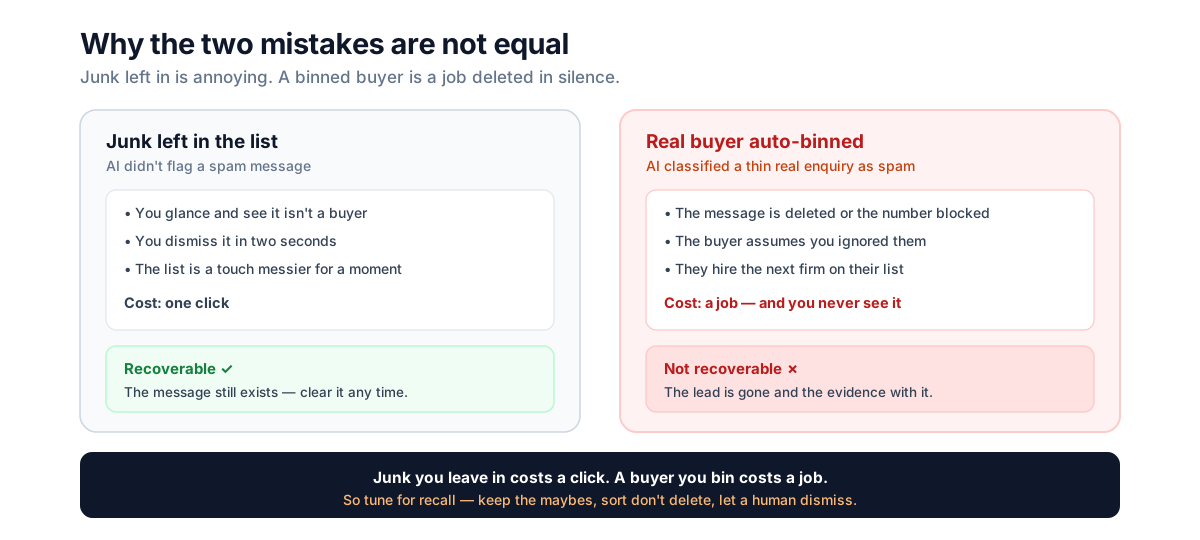
Junk left in the list (the AI didn't flag it) is recoverable. You see a wrong number or a supplier pitch, you dismiss it in two seconds, the list is a touch messier for a moment. Mildly annoying — but nothing is destroyed, and you can clear it whenever you like.
A real buyer auto-binned (the AI classified a genuine enquiry as spam) is not. The message is gone or the number is blocked. The buyer, who sent you a shy three-word enquiry, sees no reply, assumes you can't be bothered, and messages the next firm on their list. You didn't just lose a lead — you lost it invisibly, because the evidence that a buyer ever reached out got deleted with it. There's no post-mortem to do.
This is the settled position of the field. Spam-filtering research has held for twenty years that judging a legitimate message to be spam is far worse than letting a spam through — organisations treat a wrongly filtered real message as a much bigger problem than the occasional junk that slips past. One classic framing: the worst cost isn't the spam you delete, it's the request-for-proposal a consulting firm never receives because a filter ate it — an opportunity you can't count because you never saw it. Estimates put the cost of finding one wrongly filtered legitimate email at several times the cost of deleting a spam, and even a filter with a sub-1% false-positive rate — the accepted "good" ceiling — is one people resent, because a single missed important message poisons their trust in the whole thing. Your renovation inbox is that logic with money attached: the "false positive" isn't an annoying retrieval, it's a RM1,280 job.
Why do your thinnest real leads look the most like spam?
Because low information at the door isn't a sign of a low-value buyer — it's usually a sign of an early one, and early is the most valuable position you can hold. This is the cruel overlap that makes an aggressive filter backfire.
A serious first-time renovator often opens with almost nothing: "hi, renovate, how much ah," or a single blurry photo of a kitchen with no caption. On the surface that's indistinguishable from a bot blast — no name, no unit, no budget, no full sentence. But as the vague-enquiry piece argues, a message that thin usually means the buyer is at the very start of their search and hasn't contacted anyone else yet. A detailed, polished brief often means another firm already educated them and you're quoting last. The three-word photo means you might be first — and being first is the advantage that wins most competitive deals.
So the leads a tight filter is most likely to bin as "too thin, probably junk" are precisely the leads where your edge is biggest. Optimise for a clean inbox and you throw away your best opportunities to keep your worst ones out. That's the exact inversion you don't want.
The one fact the chat can't always tell you
Some of the hardest calls aren't spam-versus-lead at all — they're lead-versus-rival, and that's a fact the message often doesn't contain. "What's your rate for a condo kitchen ah" could be a genuine buyer or a competitor benchmarking you to undercut. "I want to supply your tiles" is a pitch you'd route away — unless you actually need a new tile supplier, in which case it's useful. The deciding fact — who is really on the other end and why — lives off-channel, which is the one-question test that runs through this whole series: when the answer isn't written in the chat, keep the judgment human.
There's a neat Malaysian wrinkle here too. Under the Communications and Multimedia (Amendment) Act 2025, a new Section 233A defines spam — an unsolicited commercial electronic message — as one sent "where there is no prior relationship between the sender and the recipient, or no prior consent from the recipient," explicitly covering WhatsApp, SMS and social media (the provision is enacted but not yet in force). Read that definition against your inbox and something clicks: the line the law itself draws is about whether the sender initiated a relationship — which is exactly the thing you can't always read off the surface of a single message. A real buyer initiating contact and a competitor faking one look identical at the door. The regulator is drawing the same distinction you are, and finding it just as hard to automate.
So what did the build that actually paid look like?
The one that flips the job: AI sorts, it never deletes — and it's tuned to keep the maybes. Same division of labour that's earned its keep at every other step of this chain: let AI do the reading, keep the irreversible action human.
- When a message is obvious junk — a phishing blast, a "be your agent" pitch, a loan-spam template — AI moves it to a side lane and surfaces one prompt: "Looks like a supplier pitch, not a buyer — dismiss?" The owner taps yes, or (rarely) no. Nothing is deleted; it's de-prioritised, and it's one tap to clear or recover.
- When a message is ambiguous — a thin "renovate, how much," a bare photo, a "what's your rate" that could be a rival — it stays in the main lane and is treated as a real lead. When in doubt, it's a buyer. The whole system is tuned for recall: catch every possible real lead, tolerate some junk in the list.
- It never auto-deletes or auto-blocks, no matter how confident it looks. The delete is the destructive act, so the delete is the human's — a two-second dismiss, not a silent execution.
| Build A — auto-delete the spam | Build B — sort, never delete | |
|---|---|---|
| What AI does | Classifies and removes junk on its own | De-prioritises likely junk, flags for a human |
| Tuned for | A tidy inbox (precision) | Never losing a buyer (recall) |
| Ambiguous message | Risk of deletion | Treated as a real lead |
| Wrong call cost | An invisible lost job | A two-second dismiss |
| Who owns the delete | The model | A human, one tap |
That's the entire design principle, and it's the same one that worked when AI updated the CRM (draft the note, keep the stage verdict human), when AI merged duplicates (propose the merge, never fuse), and when AI tagged the lead source (read the stated cue, never guess). AI reads and proposes for a fraction of a sen; the human owns anything you can't cleanly undo — and a deleted buyer is the least undoable thing in your inbox.
What should an owner actually do about inbox junk?
Spend your effort on making junk cheap to dismiss and a real lead impossible to lose — not on a clever auto-deleter. Most of the win is upstream of any AI.
- Auto-acknowledge every inbound, before triage. An instant auto-greeting on every message means even a shy real buyer is answered the moment they message — so a thin lead is never lost while it waits to be sorted. Greeting a wrong number costs nothing; greeting a real buyer at the door wins the first-responder edge.
- Let AI sort to a side lane, never delete. Treat a "probably junk" flag as a prompt to glance, not a decision. Clear it in one tap.
- When in doubt, it's a lead. Internalise the asymmetry — junk left in is a click, a buyer binned is a job. Tune every threshold toward keeping the maybes.
- Give every lead one owner by rule. A human watching a conversation is your best spam filter — and your best radar for a competitor probe. A lead lost in the group chat with no owner is the one that gets ignored as noise.
- Answer a "what's your rate" with value, not a naked number — until you know it's a real buyer. It costs a rival nothing useful and still gives a genuine buyer a warm, fast reply.
- Handle the five kinds differently. A wrong number gets one line; a mass broadcast gets a low-effort reply, not your best quote; a real thin lead gets the full qualify-on-first-reply treatment.
How HotLead fits — honestly
I'll be straight, the way I try to be in every one of these, because over-claiming is the hype I keep arguing against. HotLead does not ship an AI spam-detector that reads your inbox and deletes junk — the auto-deleter is the experiment in this piece, and the whole piece is an argument for why it shouldn't run unattended. What HotLead gives you is the groundwork that makes junk cheap and a real lead impossible to lose in the noise:
- Capture and auto-greet every inbound. Every WhatsApp, Facebook or Qanvast message lands on one record and gets an instant auto-greeting — so a shy real buyer is acknowledged the moment they message, before anyone has decided whether it's junk. That single mechanic quietly solves the recall problem: you never lose a lead to triage.
- One owner per lead, by rule. Round-robin, manual, or a custom rule by area or source. A named human on each conversation is the best spam filter you have — the one who'll spot the rival probe and rescue the thin-but-real buyer.
- A next action and overdue nudge on every lead, so a message that looked like junk but was real can't just fall silent forever.
- A funnel and per-channel view that shows where your genuine leads come from — so you can tell a channel full of junk from a channel full of buyers, and stop treating Facebook-ad enquiries like the mass broadcasts they arrive next to.
The is-it-a-buyer judgment stays with you, where it belongs. If a noisy, leaking inbox is the problem underneath all this, start with the complete guide to managing renovation leads in Malaysia, see how it fits a renovation firm or an interior design studio, or read the companion builds on what AI still can't do and spotting duplicate leads.
Sources: That Malaysian authorities blocked roughly 2.1 billion suspicious calls and unsolicited messages between 2022 and August 2025, and that MCMC has repeatedly warned of WhatsApp accounts impersonating banks to harvest credentials, from 2025 Malaysian scam-and-spam reporting. The Section 233A / unsolicited-commercial-electronic-messages framework under the Communications and Multimedia (Amendment) Act 2025 — its definition of spam as a message sent with "no prior relationship between the sender and the recipient, or no prior consent," its coverage of WhatsApp, SMS and social media, and its enacted-but-not-yet-in-force status — from Low & Partners' legal update on the UCEM framework and the MCMC public consultation coverage. The spam-filtering principle — that a legitimate message wrongly filtered is far more costly than a spam that slips through, that the accepted "good" false-positive ceiling is under 1% and users still resent it, that the worst cost is an opportunity you never see (the classic "an RFP a consulting firm never receives"), and that locating one wrongly filtered legitimate message costs several times more than deleting a spam — from the Process Software false-positives whitepaper and DuoCircle on handling false positives and negatives. The competitor "fake estimate" market-research tactic is a documented contractor practice, described here as anecdotal, not a measured rate. The ~90.7% WhatsApp-for-business figure and the first-responder advantage are reused from earlier pieces in this series; renovation lead-volume (40–60 enquiries a month) and the ~RM1,280 expected gross profit per enquiry are typical operating numbers reused from the cost-of-a-lost-lead and funnel-benchmarks pieces and labelled as typical; the classification experiment and the per-message AI cost are described from practice and labelled illustrative, not a controlled trial or a quoted price.
Frequently asked questions
Can AI filter spam and non-leads out of my renovation WhatsApp inbox?
It can sort the obvious junk well — bot blasts, phishing, loan and recruitment spam, and copy-paste "contractor wanted" broadcasts are exactly the patterns a classifier reads reliably. What it should not do is auto-delete or auto-block. In an inbox the two mistakes aren't equal. A piece of junk left in the list is a two-second dismiss and fully recoverable. A real buyer wrongly binned is an invisible lost job — the message is gone, the buyer assumes you ignored them, and you can't even see it happened. So the safe build has AI de-prioritise likely junk to a side lane and flag it for a one-tap human dismiss, never delete it, and treat anything ambiguous as a real lead.
Why is auto-deleting a suspected spam so risky?
Because your thinnest, most valuable real leads look the most like spam. A first-time renovator often opens with three words — "hi, renovate, how much" — or a single blurry photo of their kitchen, no name, no unit, no budget. That's indistinguishable on the surface from a bot blast. But a message that thin usually means the buyer is at the very start of their search and hasn't contacted anyone else yet, so you're the first firm in — the highest-value position there is, worth roughly the first-responder edge that closes most competitive deals. An aggressive auto-filter throws those away to keep the inbox tidy. That's tuning your system to make the expensive mistake.
What kinds of non-leads actually fill a contractor's WhatsApp?
Five rough kinds. Bot and phishing blasts (the impersonation and credential-harvesting messages MCMC keeps warning about). Wrong numbers — the very Malaysian "sorry, salah orang." Competitor probes — a rival messaging as a fake homeowner to fish for your rates. Inbound pitches — "I want to be your supplier / agent / subcon," plus recruitment, loan and marketing spam. And mass broadcasts — the "contractor wanted, please quote" copy-paste forwarded to fifty firms, which is technically a lead but a near-worthless one you're one of fifty on. Each needs different handling, and giving all five the same fast, careful reply you'd give a real buyer is the waste.
Isn't a competitor asking for my rates just a lead I should answer fast?
No — and this is a fact the chat alone often can't settle. A message like "what's your rate for a condo kitchen ah" could be a genuine first-time buyer or a competitor benchmarking your price to undercut you. Answering fast and fully is right for the buyer and wrong for the rival, and you frequently can't tell which from the text. That's exactly the off-channel limit that recurs across this series — when the deciding fact isn't in the message, keep the judgment human. The safe move is to reply with your value and your process rather than a naked number until you know it's a real buyer, so a probe costs a rival nothing useful and a real buyer still gets a warm, fast response.
Does HotLead automatically detect and delete spam leads?
No, and I won't pretend it does — the auto-deleter is the experiment in this piece, not a shipped feature, and the whole piece argues against letting it run unattended. What HotLead gives you is the setup that makes junk cheap and a real lead impossible to lose. Every inbound is captured onto one record and gets an instant auto-greeting, so even a shy real buyer is acknowledged the moment they message, before anyone has triaged anything. Every lead gets one owner by rule, so a human — the best spam filter you have — is watching each conversation. And a next-action and overdue nudge means a thin lead that looked like junk can't just fall silent forever. The is-it-a-buyer judgment stays with you.
Keep reading
- "Did They Even See It?" I Built an AI to Read the Silence After a RM62k Renovation QuoteA Puchong reno firm sends a detailed RM62k kitchen quote on WhatsApp, then gets three days of silence. Did they read it? Comparing? Sticker shock? Nobody knows, so the follow-up is a blind "just checking in" fired into the dark. The 2026 reflex is to ask AI to score the buyer's intent and auto-chase. I built it — and it confidently invented a signal it couldn't actually see, then sent the one message that re-opens the price. Here's why the honest build, which admits what it can't know, is the one that earns its keep.
- The Three Numbers That Predict Your Next Quarter of Renovation LeadsYour paid-lead numbers tell you about this month. Reviews earned per won job, your referral rate and your repeat rate tell you about next quarter — they're leading indicators of the free pipeline most reno firms only notice once it dries up. Here's how to read the three trust numbers, why you should measure behaviour instead of a loyalty survey, and how to spot a dry quarter while there's still time to prevent it.
- A Main Contractor Just Asked You to Quote a Package. Qualify the Payer First.When another contractor WhatsApps you to price a trade package, it looks like the cleanest lead of the month — a pro who knows what he wants. It's actually your riskiest, because the risk isn't the project, it's the payer. Here's how to handle it.