

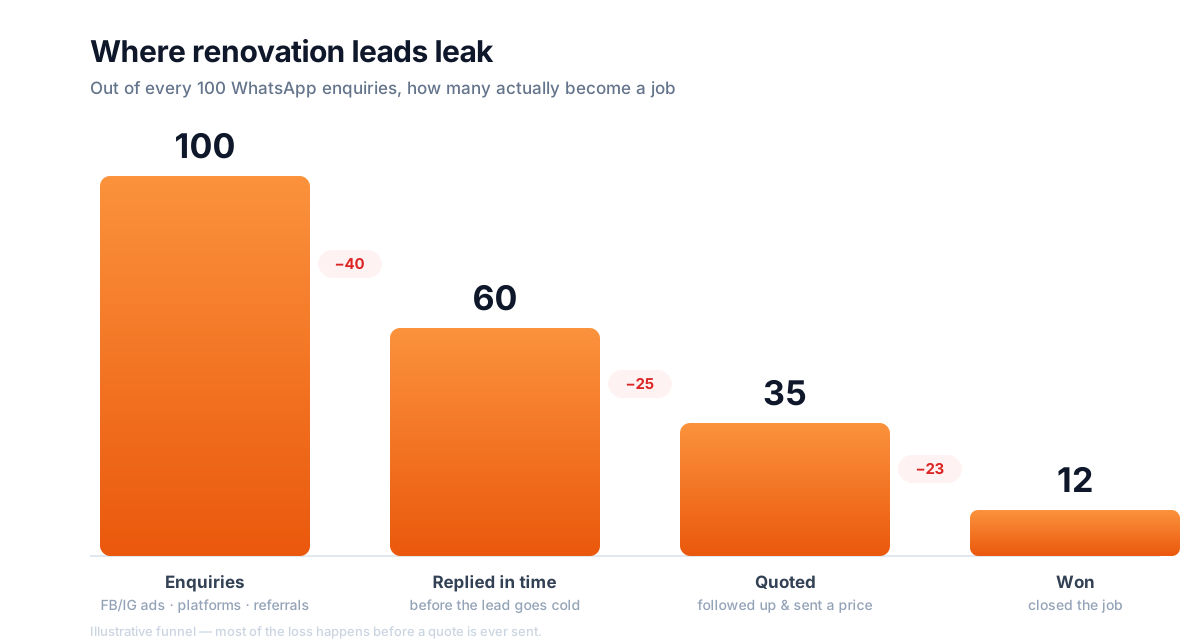
If you run a renovation or interior-design firm in Malaysia, your leads almost certainly arrive in WhatsApp — from Facebook and Instagram ads, from platforms like Atap, Qanvast and Recommend.my, and from word-of-mouth. The problem isn't getting enquiries. It's that most of them quietly die before anyone sends a quote.
Lead management is the system that stops that leak: capture every enquiry, reply fast, give each lead a clear owner, follow up until there's a yes or no, and watch where the funnel drops off. This guide breaks down each part — with the numbers — and gives you a system you can run this week.
Where do renovation leads actually come from in Malaysia?
Malaysia's home-improvement market is worth around USD 1 billion (roughly RM4–5 billion), and it's dominated by the "do-it-for-me" segment — homeowners who hire professionals rather than DIY. That's a steady stream of buyers looking for firms like yours.
They find you through a handful of channels:
- Facebook & Instagram ads — the dominant paid channel for reno firms; the "Send WhatsApp message" button is the usual call-to-action.
- Listing platforms — Atap.co (2,000+ ID firms, 6,000+ property owners connected), Qanvast, and Recommend.my match homeowners to firms.
- Referrals — friends, family, past clients. Still the most trusted channel.
- Google & Maps — people searching "renovation contractor [area]" or your firm by name.
Notice the pattern: almost every one of these funnels into a WhatsApp chat. WhatsApp reaches about 90% of Malaysian internet users — it's the default way Malaysians talk to a business. Which is great, until you realise WhatsApp is also where the leaks happen.
For the full channel-by-channel breakdown — and what each lead source is actually worth — see where renovation leads come from in Malaysia.
Why do so many leads die in WhatsApp?
Because WhatsApp was built for chatting, not for running a sales pipeline. On its own it gives you:
- No owner. A lead lands in a shared number or the boss's phone. Everyone assumes someone else replied. Nobody did.
- No reminders. "I'll follow up tomorrow" turns into next week, then never.
- No funnel view. You can't see how many enquiries came in this month, how many got quoted, or where they stalled.
- No accountability. When a lead goes cold, there's no way to tell which salesperson dropped it.
The result is the funnel at the top of this page: out of 100 enquiries, a big chunk is lost before a quote is ever sent — not at the price stage, where owners think they're losing deals.
The deeper read on plugging that specific leak: how to never miss a WhatsApp enquiry again.
How fast do you really need to reply?
Fast. Faster than feels reasonable. The single most studied number in lead management is response time, and it's brutal for slow repliers.
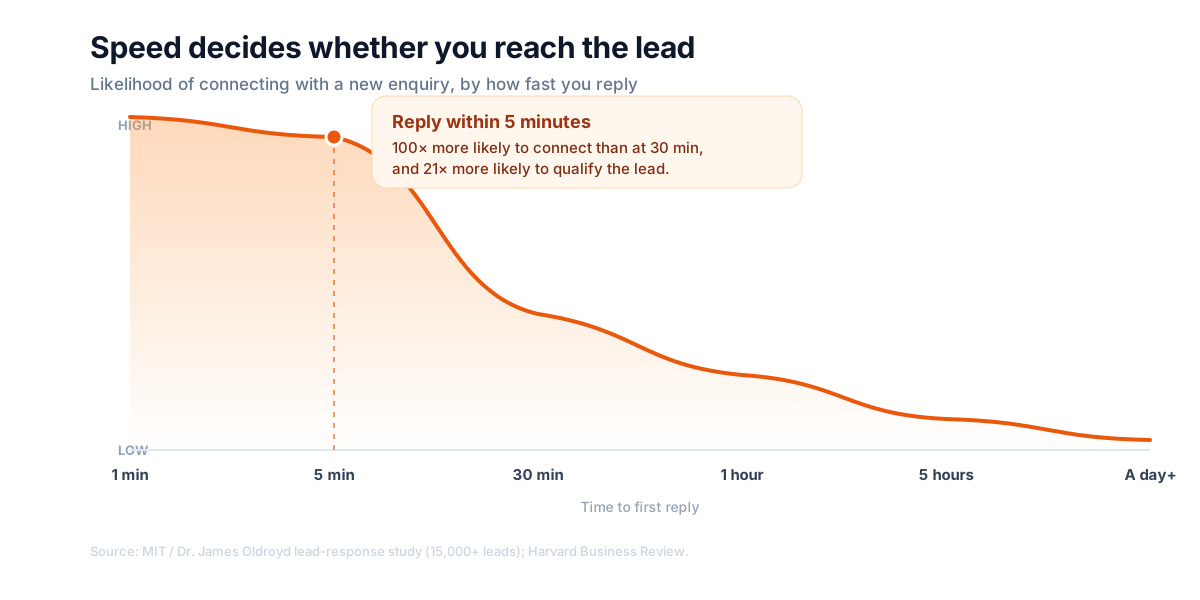
MIT researcher Dr. James Oldroyd analysed over 15,000 leads (work later popularised by Harvard Business Review) and found:
Reply within 5 minutes and you're about 100× more likely to connect and 21× more likely to qualify the lead than if you wait 30 minutes.
It gets starker:
- The average business takes ~47 hours to respond to a new lead.
- The first firm to respond wins around 78% of the deals.
- As few as 27% of leads ever get contacted at all — meaning up to 73% are simply wasted.
For a reno firm, "5 minutes" is hard when your salesperson is on a site visit. That's the real argument for a system: even if a human can't reply in 5 minutes, the lead can be instantly acknowledged, assigned, and put in front of the right person so it doesn't sit unseen for two days. The gap is worst after hours and over the weekend, when the whole team is off but the enquiries keep coming.
Two deeper reads on this: exactly how fast you should reply to a renovation lead and how response time maps to your close rate — plus what a single lost lead actually costs you.
How many times should you follow up?
Most renovation jobs aren't won on the first message — they're won on the fifth. The follow-up data is just as one-sided as the speed data:
- ~80% of sales require 5 or more follow-ups, and most happen between the 5th and 12th contact.
- But 44% of salespeople give up after one attempt, and 92% quit by the fourth.
- Spacing follow-ups 2–3 days apart lifts reply rates by around 11% versus daily nagging or long silences.
Put those two facts together and the math is uncomfortable: the deal is usually waiting at follow-up #5, but almost everyone quits at #1–#4. The firm that simply keeps following up — politely, on a schedule — wins jobs its competitors already gave up on.
This is the second thing a system fixes: it remembers who needs a nudge, and when, so follow-up #5 actually happens.
Who owns each lead?
Every lead needs exactly one name attached to it. The most common (and most expensive) WhatsApp mistake is the shared inbox — one number, several salespeople, no clear owner.
A simple routing rule beats a shared inbox every time:
- Assign each new enquiry to one salesperson the moment it arrives.
- Make that owner visible, so nobody double-replies and nobody assumes "someone else got it."
- If the owner doesn't act within a set time, reassign it — a cold lead with no owner is a lead you've already lost.
Routing is also how you answer a question most owners can't today: which salesperson is dropping leads? When every lead has an owner and a status, the pattern becomes obvious.
More on both failure modes: how leads get lost in the group chat when nobody owns them, and how to tell which salesperson is actually dropping leads.
How do you know where your funnel is leaking?
You measure four numbers, in order:
| Stage | The question it answers |
|---|---|
| Enquiries | How many leads came in this month? |
| Replied in time | How many did we actually respond to quickly? |
| Quoted | How many got a real price? |
| Won | How many became a paying job? |
The drop between any two stages is a leak. For most Malaysian reno firms, the biggest drop is between Enquiries → Replied (speed) and Replied → Quoted (follow-up) — long before price. If you can only fix one thing, fix the earliest leak first; everything downstream depends on it.
For what a healthy conversion rate at each stage actually looks like — enquiry-to-quote, quote-to-appointment, appointment-to-won — see renovation funnel stage-conversion benchmarks for Malaysia.
You cannot improve what you cannot see. A shared WhatsApp number shows you none of these numbers. That visibility is the whole point of a lead system.
Do you need a CRM, or is WhatsApp + a spreadsheet enough?
Honest answer: a generic CRM is usually overkill for a reno firm, and a spreadsheet is usually too manual to survive a busy month. Here's the trade-off:
| Shared WhatsApp | WhatsApp + spreadsheet | Purpose-built lead system | |
|---|---|---|---|
| Captures every enquiry | ⚠️ if someone sees it | ✅ if updated manually | ✅ automatic |
| Clear owner per lead | ❌ | ⚠️ manual | ✅ |
| Follow-up reminders | ❌ | ❌ | ✅ |
| Funnel / leak view | ❌ | ⚠️ if maintained | ✅ |
| Survives a busy season | ❌ | ❌ | ✅ |
| Setup effort | none | low | low–medium |
The sweet spot for most firms isn't a heavy CRM — it's a lightweight layer on top of WhatsApp that assigns leads, nudges follow-ups, and shows the funnel, without changing how your customers message you.
Three deeper reads if you're weighing tools: WhatsApp CRM vs a generic CRM for a Malaysian contractor, how to actually choose a lead-management tool, and how much lead software should really cost a reno SME — alongside the honest spreadsheet vs a lead system comparison.
A simple lead system you can run this week
Even before any software, you can plug the worst leaks:
- One owner per lead. Decide who gets each new enquiry and make it explicit.
- A 5-minute acknowledgement. Even "Hi, thanks for reaching out — sending details shortly" stops the lead from shopping elsewhere.
- A follow-up rule. Every open lead gets a nudge on day 2, day 4, day 7, day 14. Write it down.
- A weekly funnel check. Count enquiries, quotes, and wins. Watch the biggest drop.
- A reassignment rule. If an owner goes quiet on a lead for 24 hours, it moves to someone else.
Do just these five and you'll recover jobs you're currently losing. A tool should make each step automatic — not add work.
How HotLead fits in
HotLead is built for exactly this, for Malaysian renovation firms. It sits on top of your WhatsApp and:
- Sorts every incoming enquiry so nothing sits unseen.
- Routes each lead to the right salesperson with a clear owner.
- Shows you where your funnel leaks — enquiries, quotes, wins, and the drop-offs between them.
The goal is simple: stop losing leads you already paid for. If that's the leak you're trying to fix, see how it works.
Want the deeper dive on the WhatsApp problem specifically? Read why renovation firms lose leads in WhatsApp — and how to stop it.
Sources: MIT / Dr. James Oldroyd lead-response study and Harvard Business Review, "The Short Life of Online Sales Leads"; Velocify (now ICE Mortgage Technology) lead-response analysis of 3.5 million leads on the first-minute conversion lift; industry follow-up and speed-to-lead statistics; DataReportal / industry data on WhatsApp usage in Malaysia; Ken Research / Euromonitor on Malaysia's home-improvement market.
Frequently asked questions
What is lead management for a renovation firm?
It's the system you use to capture every enquiry, reply fast, route each lead to the right salesperson, follow up until there's a decision, and track where leads drop off. For most Malaysian reno firms, that flow runs through WhatsApp — which is exactly where it tends to break.
How fast should I reply to a renovation lead?
Within 5 minutes if you can. MIT research on 15,000+ leads found that replying within 5 minutes makes you about 100× more likely to connect and 21× more likely to qualify the lead than waiting 30 minutes. After an hour, your odds fall sharply.
How many times should I follow up before giving up?
At least 5 to 8 times. Around 80% of sales need five or more follow-ups, yet 44% of salespeople give up after one. Persistence, spaced a couple of days apart, is where most renovation jobs are actually won.
Do I need a CRM, or is WhatsApp enough?
WhatsApp is where your leads are — but on its own it has no owner, no reminders, and no funnel view. You don't necessarily need a heavy CRM; you need a lightweight system on top of WhatsApp that assigns each lead, nudges follow-ups, and shows where leads leak. That's the gap HotLead fills.
Where do renovation firms lose the most leads?
Before a quote is ever sent. Most loss happens in the first hours — slow replies and forgotten follow-ups — not at the price-negotiation stage. Fixing speed and follow-up usually recovers more revenue than discounting.
Keep reading
- "We Went With Another Contractor" — I Built an AI to Win Back a Lost Renovation Lead Instead of Slamming the DoorA Shah Alam firm quotes a RM70k job, chases it for three weeks, and finally gets the message every owner dreads — "thanks, we've decided to go with another contractor." The reflex is a terse "ok, all the best 🙏" and a closed chat. The 2026 reflex is to ask AI to detect the rejection and auto-fire a win-back discount. I built it, and it begged. Here's the version that keeps a near-free option on a re-win without ever chasing a no.
- The Only Three Ways to Grow a Renovation Firm — and Which Lever to Pull FirstEvery renovation firm's revenue comes down to three levers — how many leads you get, how many you close, and how big each job is. They multiply, so a modest lift on each compounds. But they cost wildly different amounts to pull, and most owners reach first for the one they should reach for last. Here's the ranking, with Malaysian numbers.
- Sight Unseen: Winning the Overseas Malaysian Who Renovates a Unit They Can't VisitA Malaysian working in Singapore collects the keys to a KL condo and messages you to fit it out — but they can't come to a site visit, can't walk your showroom, and will wire a deposit to a firm they've never met. Most firms treat this lead like a walk-in, go quiet when the buyer can't pop by, and lose the highest-budget job in the inbox. Here's why the remote buyer is your hardest-trust but best-paying lead, and how to build a remote lane that actually closes it.