

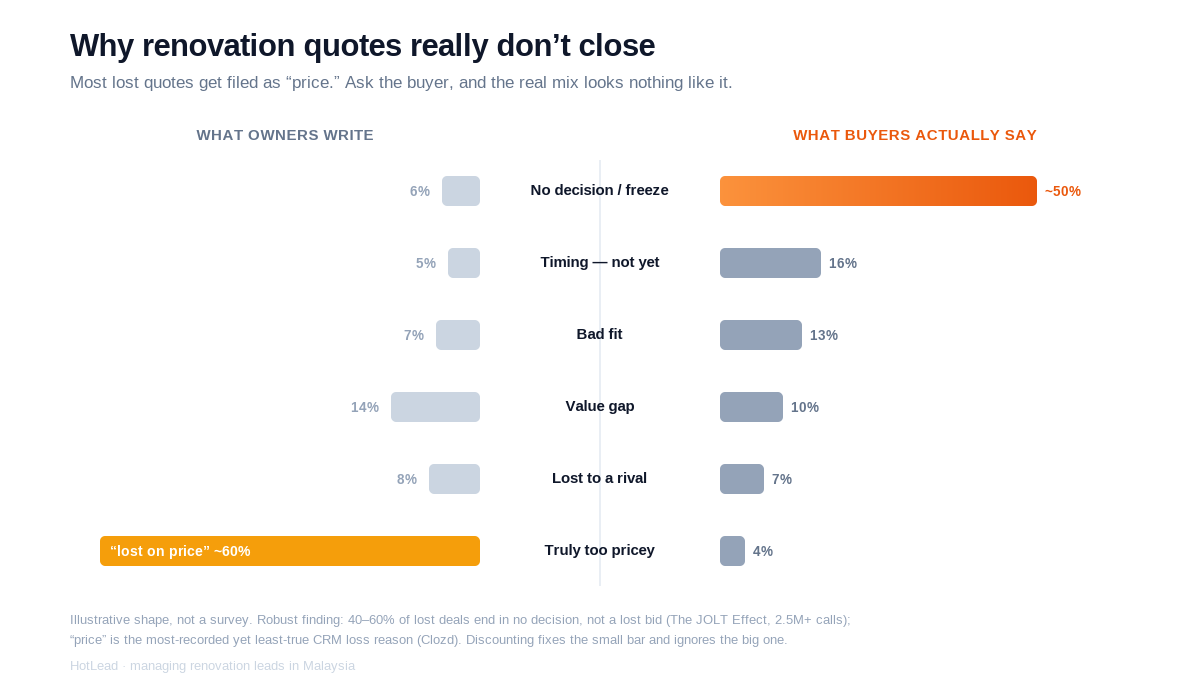
You lost nine out of every ten quotes you sent last quarter. That is normal — a healthy Malaysian renovation firm closes somewhere around 7 to 8% of its enquiries, and the quote stage is where the hardest filtering happens. So the interesting question isn't why do I lose quotes — everybody loses most of them. The interesting question is the one almost no owner asks before reacting:
Of the quotes I lost, how many did I actually lose on price?
Because the answer decides what you do next. If you believe most of them died on price, you will cut your next ten quotes to stay competitive — and quietly hand away half your margin chasing a cheaper rival who, in most of those deals, was never there. The loss reason you write down is not a note. It is an instruction to change your business. Write the wrong one and you spend real money fixing a leak you don't have while the real one keeps bleeding.
Why is "lost on price" the most dangerous thing you can write in your pipeline?
Because it's the loss reason that's easiest to write, hardest to verify, and most expensive to act on — all at once. It blames nobody's quality and nobody's follow-up, it needs no evidence, and it points straight at the one fix that feels decisive: drop the number. So it gets written far more often than it's true.
The firms that study this for a living are unanimous. Clozd, a win-loss analysis company that compares what sales reps log against what buyers actually report, finds that price is the single most common closed-lost reason recorded in CRMs — and that most deals are not actually lost on price. Its research also finds that buyers typically name four or five reasons a deal fell through, while sellers capture even one of them only about 15% of the time. The label in your pipeline is a convenient summary written by the person with the least visibility into the buyer's head.
And the convenient summary sends you to fix the wrong thing. This is the same trap as trusting a wrong source tag or reading a lead's enthusiasm as intent: a confident wrong label is a trusted wrong label, and a trusted wrong label quietly biases every decision after it. Mark enough quiet quotes "lost on price" and you'll compete on price — even on the jobs you'd have won at full margin.
What are the five real reasons a renovation quote doesn't close?
Almost every lost renovation quote fits one of five buckets — and they are not the same problem, don't cost the same, and don't share a fix. Sorting your losses into these five is the whole game. Here they are, with what each actually looks like in a Malaysian firm's WhatsApp:
- No-decision / indecision — the biggest and most invisible. The buyer doesn't go to a competitor; they go nowhere. "Let me discuss with my wife first ya", then silence. They keep collecting quotes, re-measuring, re-Pinteresting, and the project quietly slides to "next year". A renovation is a large, once-a-decade, hard-to-undo spend, so it is precisely the kind of purchase people freeze on.
- Timing / not-yet — a real deal on a real clock. Keys not handed over, loan still in underwriting, tenant not moved out, waiting for the bonus or after Raya. The intent is genuine; the date isn't here. This isn't a loss. It's a park.
- Fit — the job that was never yours. The RM30k budget for an RM90k scope, the pure price-shopper, the enquiry fishing for a free design to hand to their uncle's contractor. Losing these is good. The only mistake is spending a site visit and a custom 3D before you qualified them out.
- Value — the price-vs-worth gap. The buyer could afford it and did decide to renovate, but your number didn't feel worth it versus what they understood they were getting. This is the only bucket where "price" is partly the true story — and even here it's usually a value-communication problem, not a too-high-number problem.
- Lost to a named competitor — rarer than it feels. A specific other firm quoted a comparable scope and won it. This genuinely happens, and it's worth a real post-mortem. But it's a far smaller slice than the pipeline's "lost on price" tags imply, because "price" is routinely used to describe losses in all four of the other buckets.
Which of those losses are even yours to fix?
Three questions decide whether a loss category deserves your time and money: is it in your control, does the obvious fix actually address it, and what is the expected return on fixing it? Run the five buckets through that and the picture inverts the instinct completely — the category you tag most (price) is near the bottom of the fix-worthiness list, and the category you never tag (indecision) is at the top.
| Loss reason | Roughly how big | Is it yours to fix? | The reflex fix | What actually works | Verdict |
|---|---|---|---|---|---|
| No-decision / indecision | Largest | Yes — mostly | Discount (makes it worse) | De-risk the decision: recommend, cut options, references, written warranty, phased start | Fix first |
| Timing / not-yet | Large | Partly | Chase harder / discount to "lock in" | Park with a wake-date; one light touch per milestone | Nurture, don't fight |
| Fit (never your job) | Moderate | Yes — upstream | Keep quoting / drop price | Qualify earlier so you never quote it | Fix the input, not the loss |
| Value (price vs worth) | Moderate | Yes | Cut the number | Communicate the scope; show what the cheap quote left out | Fix the message, sometimes the price |
| Lost to a named competitor | Small | Sometimes | Match their price | Honest post-mortem: speed, trust, scope — then decide | Worth a look, not a panic |
Notice what falls out of this. The reflex response to almost every lost quote — drop the price — is the right move for at most one and a half of the five buckets, and it's actively harmful for the biggest one. An owner who reacts to a slow quarter by shaving every quote is optimising for the smallest, rarest category of loss while ignoring the largest.
Why does a discount make your biggest loss category worse?
Because an indecisive buyer isn't weighing your number against a rival's — they're weighing the terror of committing RM80,000 to a decision they can't easily reverse. A discount adds a variable; it doesn't remove the fear. In fact it often deepens it: a sudden price drop reads as "so the first number was inflated — what else is soft here?", which feeds exactly the distrust that froze them.
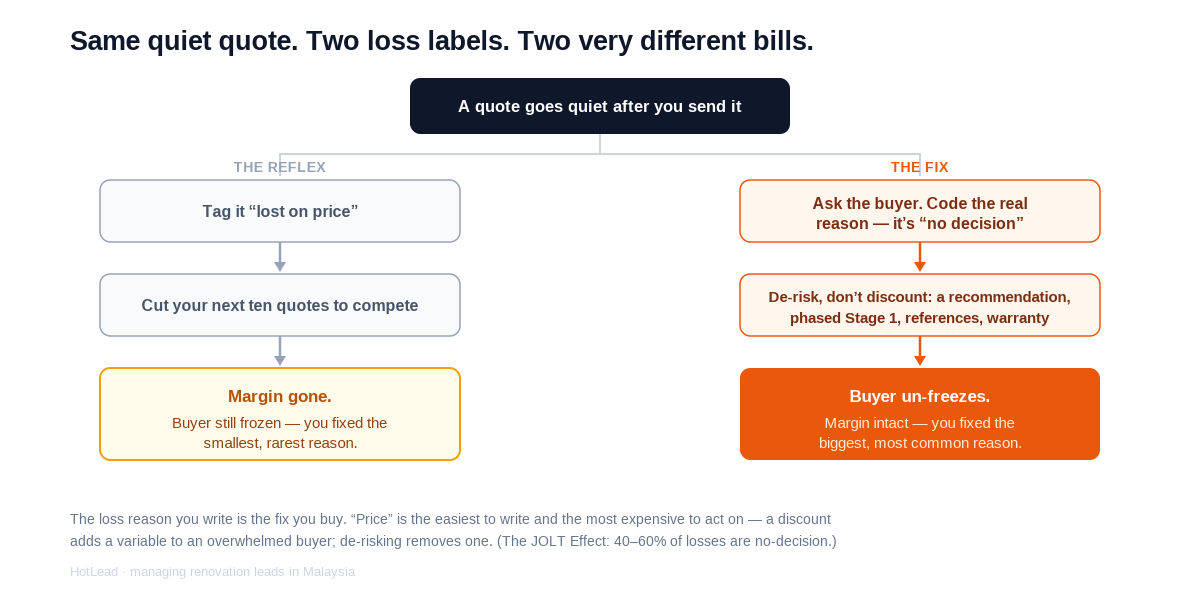
The research that reframed this is Matthew Dixon and Ted McKenna's The JOLT Effect, built on an analysis of more than 2.5 million recorded sales conversations. They found that 40 to 60% of lost deals end in "no decision" rather than a competitor win, and that roughly 56% of those no-decision losses are driven by the buyer's own indecision — the fear of making a wrong, expensive choice — not by a preference for the status quo and not by price. Gartner's buyer research points the same way: customers overwhelmed by conflicting, high-quality information were 153% more likely to settle for a smaller purchase than planned — or none at all — and the single biggest obstacle in a considered buy is the buyer's shaky confidence in their own judgement.
The move that works on a frozen buyer is the opposite of a discount — you take the risk and the overwhelm off the table:
- Prescribe, don't present. Instead of three packages and ten finishes, tell them what you'd do in their unit and why. Choice is a burden to an anxious buyer, not a gift.
- Make the first commitment small and reversible. A phased start, a paid detailed-design stage, a defined Stage 1 — anything that lets them move without betting the whole RM80k at once.
- Borrow trust they don't have yet. A reference from a past job in their condo or taman, before-and-afters, a written workmanship warranty. In a market with light contractor regulation and real scam anxiety, proof is worth more than a price cut.
And keep the price lever in its holster unless you genuinely know a named rival quoted the same scope lower. Reopening the number only ever moves it one direction — down — so every ringgit you concede to a buyer who was actually just unsure is pure margin given away for nothing. (If you do need to negotiate, do it with the margin maths and the discount decision in front of you, not on reflex.)
How do you find the real reason without guessing?
You ask the buyer — because the real reason almost never made it into the chat — and then you code every loss the same way so the pattern can show up. The honest truth is that the cause of a lost renovation quote usually lives off-channel: in a family conversation, a spouse's gut feeling that your firm "looked too small for such a big job", a competitor's quote you never saw. The WhatsApp thread holds the symptom (silence after the quote), not the cause.
So two disciplines turn guesses into data:
- Ask once, briefly, without pressure. "Hi, we've closed off your kitchen enquiry on our side — totally fine if you've gone another way. Mind if I ask what tipped your decision? Helps us improve." Most people answer an honest, no-pressure question, and the answer is worth more than the story in your head. (Occasionally the answer re-opens a deal that had only stalled on indecision — the opposite of what a "lost on price" tag would have told you to do.)
- Code every lost quote into the same five buckets, then read the pattern. One lost job is a story; twenty sorted losses are a signal. If your dead quotes cluster at one stage (all right after the number lands) or one source (all boosted-post leads), that's your leak — and it is almost never "price".
This is also exactly the line where Kai's experiment on getting AI to read dead chats and guess the loss reason lands on a warning: an AI told to auto-tag a cause for every dead deal will invent a fluent, confident reason — and it drifts to the last visible line, usually the buyer's polite price cover. Let a tool propose and show its evidence if you like; keep the verdict human, and go ask.
Where HotLead fits (and where it doesn't)
Be clear about the boundary. HotLead does not tell you why you lost a deal, and it does not auto-tag a loss reason — because that reason lives in the buyer's head, not in the chat, and a confident wrong tag is worse than an honest blank. What HotLead does is make the honest post-mortem possible instead of theoretical:
- Capture every enquiry on one record, tagged by source — so the whole dead thread is still there when you go back to ask, and so you can read loss reasons by channel (do your boosted-post leads die at a different stage than your referrals?).
- One owner per lead, with next-action and overdue flags — so "ask why we lost this one" becomes a tracked step, and a timing loss gets a wake-date ("keys handed over in Jan — reopen then") instead of being forgotten or nagged.
- The funnel and per-channel view — so you see where quotes die, at which stage and from which source, and read your losses as a pattern you can fix rather than a feeling you react to.
The reason most firms can't do this isn't that they disagree with it — it's that a shared WhatsApp number and a memory can't hold twenty dead threads, let alone sort them. HotLead's own setup is done-for-you with training, and it carries a money-back guarantee — a full refund if you're not happy after a month.
For the whole system this sits inside — capture, reply, qualify, quote and follow up — start with the complete guide to managing renovation leads in Malaysia. From here, the natural next reads are what one lost lead is really worth, when to chase a quiet quote and when to park it, and how many follow-ups actually pay. If you run a renovation firm or an interior-design studio, sorting your lost quotes by reason is the cheapest piece of market research you'll ever do — and the one most likely to stop you discounting your way out of a problem you don't have.
Sources: No-decision and indecision figures — Matthew Dixon & Ted McKenna, The JOLT Effect (2022), built on an analysis of more than 2.5 million recorded sales conversations; the 40–60% of lost deals ending in "no decision" and 56%-of-those-driven-by-indecision figures are stated by Dixon in this CustomerThink interview and summarised by Challenger and the Learnit podcast. Price as the default (and usually wrong) CRM loss reason, buyers naming four-to-five reasons, and reps capturing ~15% — Clozd, the win-loss analysis firm, from its own research comparing CRM-logged reasons against buyer interviews (vendor research; treat the exact 15% as directional). Buyer confidence and information overload — Gartner's 2019 B2B buying research (Gartner press release, reported by Sales & Marketing Management); the "153% more likely to settle for a smaller purchase" figure is from that Gartner research as reported in trade coverage. Malaysian buyers advised to collect at least three quotes and the cheapest-quote-omits-scope warning — Recommend.my, propcashflow.my and malaysia4u; the note on lighter contractor regulation in Malaysia versus Australia and Singapore is also from Recommend.my. Referral-versus-cold close rates (25% vs ~9%) via Prospeo. These are predominantly US and global sales datasets across mixed industries, so treat the exact percentages as directional shape rather than reno-specific law — the robust finding is that "no decision" and indecision, not price, are the dominant reasons considered purchases don't close. The ~7–8% blended close rate, the RM80,000 / 20% margin / RM16,000 gross-profit job, and the per-category loss shares in the worked example are the illustrative house figures used across this series; sort your own lost quotes into the five buckets for a quarter and read back your real mix.
Frequently asked questions
What is the most common reason a renovation quote doesn't close?
Not price — indecision. Across 2.5 million recorded sales conversations analysed in The JOLT Effect, 40 to 60% of lost deals ended in no decision rather than a loss to a competitor, and about 56% of those no-decision losses were driven by the buyer's fear of making a wrong, expensive choice. A renovation is a big, once-in-a-decade, hard-to-reverse spend, so it is exactly the kind of purchase a Malaysian homeowner freezes on — they keep gathering quotes, "discuss with family", and quietly do nothing. The quote didn't lose to a cheaper firm. It lost to the buyer's own uncertainty, which is why "lost on price" is usually the wrong label and a discount is usually the wrong fix.
Isn't price really the reason most of the time?
Far less often than it feels, and the people who study this for a living keep finding the same thing. The win-loss firm Clozd, which compares what sales reps log in the CRM against what buyers actually say, reports that price is the single most common closed-lost reason recorded — and that most deals are not actually lost on price. "Price" is simply the easiest thing for a buyer to say ("a bit over our budget lah") and the easiest thing for an owner to write, because it blames nobody's quality or follow-up and closes the file. In Malaysia, where buyers are told to collect at least three quotes and the cheapest one is usually cheap because it quietly left out waterproofing or a proper electrical scope, a polite "your price a bit high" very often means "I wasn't sure enough to commit to anyone yet."
Should I discount to win back a quote that went quiet?
Usually no. If the quote went quiet on indecision or timing — the two biggest categories — a discount adds another variable for an already-overwhelmed buyer to weigh, and it trains them that your price was soft to begin with. Worse, reopening the number only ever moves it down (the anchor is set), so you give away margin without addressing the actual blocker. What moves a frozen buyer is taking risk off the table — a clear recommendation instead of ten options, a reference from a past job in their condo or area, a written workmanship warranty, a smaller phased first stage. Save the price lever for the rare case where you genuinely know a named competitor quoted the same scope lower — and even then, see our discount pieces first.
How do I actually find out why I lost a renovation job?
Ask, once, briefly, and without pressure — because the real reason almost never gets typed into the chat. A short face-saving message works — something like "Hi, we've closed off your kitchen enquiry on our side, totally fine if you've gone another way, mind if I ask what tipped your decision? Helps us improve." Clozd's research found buyers typically name four or five reasons a deal fell through while sellers capture even one of them only about 15% of the time, so the guess in your head is almost certainly incomplete. Then code every lost quote into the same five buckets (no-decision, timing, fit, value, lost bid) and read them as a pattern by source and stage each quarter. One lost job is a story; twenty sorted losses tell you which leak is real.
Does HotLead tell me why I lost a deal?
No — and it shouldn't pretend to, because the real reason lives off-channel, in the buyer's head or a family conversation you never saw. What HotLead does is make an honest post-mortem possible — every enquiry captured on one record so the whole dead thread is still there when you ask; one owner per lead with a next action and an overdue flag, so "ask why we lost" and "wake this parked quote when the keys are handed over" become tracked steps instead of good intentions; and a funnel plus per-channel view so you can see where quotes die — which stage, which source — and read loss reasons as a pattern instead of a feeling. The judgment of why this one actually died stays with you.
Keep reading
- Can AI Reply to Your Renovation Firm's 1-Star Review? I Built It — and the Risk Is How Fast It ApologisesA 2-star review on Google or Qanvast is the first thing your next renovation lead reads — and most firms either ignore it or fire back and make it worse. The 2026 reflex is to let AI write the reply. I built it, and drafting a calm response costs a fraction of a sen. But an AI tuned to be helpful apologises too fast — it will concede a fault in writing, promise a refund that never happened, and grovel to a fake review from a competitor. Here's the build that protects your rank instead of torching it.
- Which Lead Signals Actually Predict a Sale? Reverse-Audit Your Own Won JobsMost firms grade a renovation lead on signals that feel predictive — enthusiasm, a long message, a fast reply — and never check whether those signals actually separate won jobs from lost ones. Here is how to run a reverse-audit on your own closed deals, which signals usually survive it, and why your pipeline is too small to pretend the score is more than directional.
- The "I Only Deal With the Boss" Lead: When the Buyer Refuses Your TeamYou finally hired someone to share the load — then the buyer messages "can I deal with you direct ah, boss?" and refuses to engage your staff. Every big lead quietly re-centralises onto the one person already maxed out, and your firm can never grow past the owner. Here's why caving caps you, why a flat "my staff will assist" loses a nervous buyer, and the move that keeps both.