

A renovation-firm owner in PJ told me about the one that still bugs him. He'd done everything right. Replied fast, ran a good site visit, sent a clean RM32k quote for a Bangsar condo kitchen to a buyer who was warm — asking the right questions, nodding along, "looks good, let me confirm with my wife." Then nothing. And because he was buried on three live sites that fortnight, "nothing" didn't register as a problem. It just sat there. Six weeks later he pinged to check in and got the reply every owner dreads: "oh, so sorry, we already went with another contractor."
He didn't lose that job on price, or on the quote, or on any decision he'd regret. He lost it to silence nobody noticed. The deal was quietly dying in his pipeline for a month and there was no moment where anyone chose to let it go — it just cooled while his attention was elsewhere. Which is why he asked me the very 2026 question: "Can't AI just watch my pipeline and tell me which deal is about to die, so I catch it in time?"
Short answer: yes — but the obvious way to build it makes things worse, and understanding why is the whole point. Because I built the obvious version first, and it failed in an instructive way.
What does a stalling deal actually cost — and why is it the lead most worth saving?
The deal going cold is usually the most valuable lead you have, which is what makes losing it to silence so expensive. A stall doesn't happen at the top of the funnel where leads are cheap and plentiful. It happens deep — on a sent quote, a booked-but-unsigned buyer, a thread that was warm last week. That's a lead you've already spent the most expensive things a reno firm gives away on: the reply, the site visit, the hours building the quote.
Put a number on it. A winnable renovation lead carries roughly RM1,280 of expected gross profit — job value times margin times its real chance of closing. A lead that's already at the sent-quote stage is worth far more than that average, because it's cleared most of the funnel's drop-off points. Losing a fresh enquiry stings a little. Losing a quote you spent an evening on, to nothing but inattention, is the leak that actually moves your year.
And here's why it's structural rather than a discipline problem: the owner who should be watching the pipeline is the same person who's physically on a job site during the exact hours a deal needs a nudge. Nobody decides to let a warm quote die. It dies in the gap between "I'll follow up when I get a minute" and the next fire. A firm doing 40 to 60 enquiries a month has more warm-but-quiet deals in flight than any busy owner can hold in their head. So the idea of a watchdog — something that watches the pipeline so you don't have to — is genuinely good. The trouble starts with how you build it.
So can't AI just watch the pipeline and flag every deal at risk?
That's the reflex build, and it's worth knowing it already exists — this isn't some exotic AI idea, it's a shipped feature in the big CRMs. HubSpot has inactive-deal cards and stagnation workflows that flag any deal with no logged activity for 14+ days and email the owner. Salesforce's Einstein Deal Insights marks deals "at risk" and "needs attention," picking up on signals like no activity in 10+ days, a stuck stage, or a pushed close date. Sales-tooling guidance from firms like Outreach says to review any deal with no activity in 14 days and treat one as stale at 1.5 to 2 times its median days-in-stage.
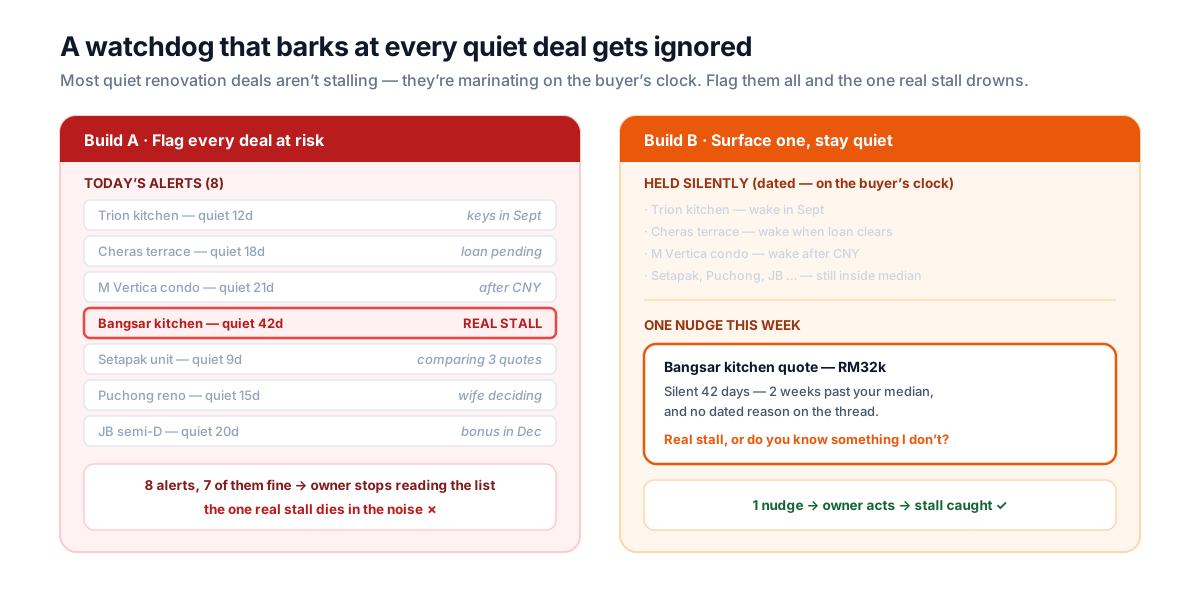
So my Build A just did the obvious thing for a WhatsApp reno pipeline: watch every open deal, and every morning surface a list of the ones that had gone quiet — no reply for a while, a quote sent with no response, a booked visit with no follow-up message. "Here are your 8 deals at risk today, boss."
It detected beautifully. It read the threads, spotted the silences, ranked them by days-quiet. On a pure "did it find the quiet deals" test, it scored close to perfect. And it was useless — actually worse than useless. Here's why.
So what went wrong when I let it bark at every quiet deal?
It cried wolf, every single day, because in renovation most quiet deals aren't stalling — they're marinating. And a watchdog that can't tell those apart barks constantly, until you stop hearing it.
Think about why a renovation deal goes quiet. Overwhelmingly, it's not because the buyer went cold. It's because the buyer is on their own clock, and that clock is loaded with long, dated waits that have nothing to do with you:
- They're waiting for their home loan — pre-approval, application and approval stack up to several weeks in Malaysia before money is even available.
- They're waiting for vacant possession — the keys to a new unit that might be months away, on a date they can't change.
- They're comparing three to five firms, because that's how a considered RM80k purchase gets made.
- They've hit the festive freeze — "let's talk after CNY," "after Raya lah" — when household decisions pause entirely.
None of those are stalls. They're the normal, healthy rhythm of a big renovation decision. But to a watchdog that only measures "days since last message," a buyer waiting on their September keys looks identical to a buyer who quietly signed with a competitor. So Build A flagged all of them. Eight alerts on Monday, seven of which were deals doing exactly what they should. By Wednesday the owner was skimming the list. By the second week he'd stopped opening it — and the one genuinely stalling deal was sitting in that list, unread.
This is not a quirk of my prototype. It's a well-documented failure mode with a name — alert fatigue — and the numbers from the field it comes from are brutal. Security teams drown in alerts, roughly half of which turn out to be false positives; an IDC/FireEye survey found more than a third of analysts simply ignore alerts when the queue is full. When most alerts are false alarms, people stop trusting all of them — and the real threat slips through because of the noise, not despite it. That's precisely what a fire-on-every-quiet-deal watchdog does to a renovation owner. It's the same trap as an AI weekly report that flags panic every week: an alarm that goes off constantly is one you learn to switch off.
Why is telling a stall from marinating so hard — and what's the signal that separates them?
Because "days since last message" — the one number the reflex build runs on — genuinely can't distinguish a dying deal from a patient one. To separate them you need two things a generic threshold doesn't have, and both are un-Googleable in the sense that they come from how renovation actually works, not from a sales-tooling blog.
One: your own median, not a borrowed 14 days. The standard "no activity in 14 days" rule is built for fast B2B software pipelines. A sent renovation quote silent for 14 days is often completely normal — the buyer is comparing quotes and waiting on financing. Apply the SaaS number and your watchdog screams on day 15 of a deal that's marinating perfectly. The threshold has to be your median time-to-close for that stage, which for a financed reno runs in weeks to months. Same principle as the tools recommend — stale at 1.5 to 2 times the median — but the median has to be a renovation one.
Two: whether the silence has a dated reason attached. This is the real key. A renovation "not now" is almost always pinned to a concrete future event — the keys in September, the loan clearing, after the bonus, after CNY. That date is usually sitting right there in the WhatsApp thread. So the signal that separates a stall from marinating isn't time-since-last-message alone. It's time-since-last-message minus any dated reason the buyer already gave you. A deal that's gone quiet with a dated reason and the date hasn't arrived is marinating — leave it alone, hold the wake-date. A deal that's gone quiet with no dated reason and has run past your median is a real stall.
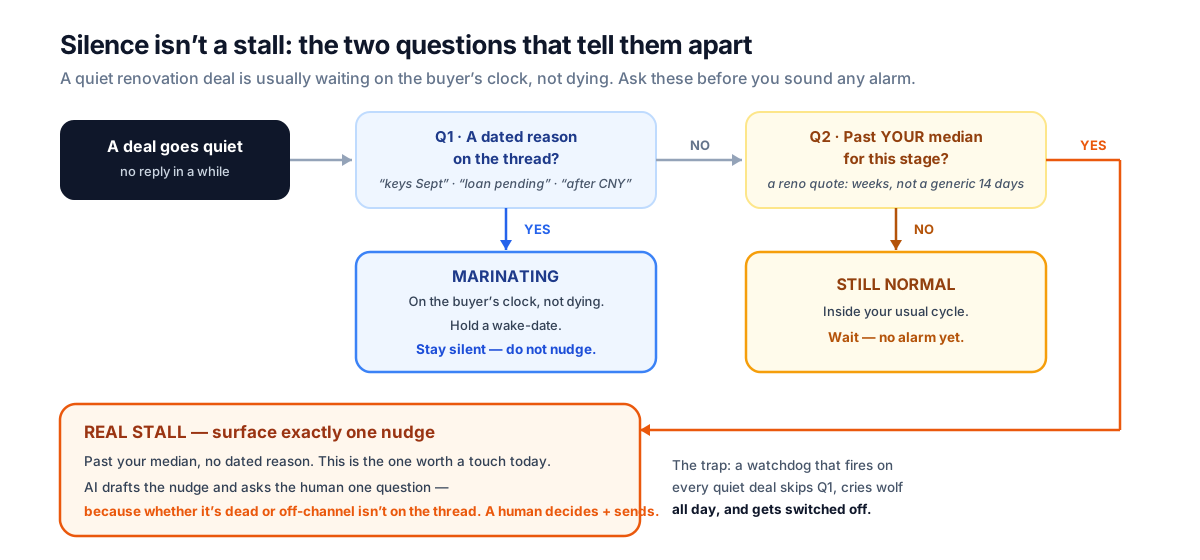
Reading that dated reason out of a messy Manglish thread is exactly what AI is good at — extracting "waiting for keys end of Sept" from a chat and understanding it's a future event. Deciding whether the buyer is telling the truth, or whether something happened off-channel that the thread can't see, is exactly what it's bad at. Which points straight at the split. Here are the three kinds of quiet, and only one of them should ever set off an alarm:
| The quiet deal | What it looks like | The signal | What it deserves |
|---|---|---|---|
| Dated wait | "After we get our keys in Sept" | A concrete future date on the thread | Hold a wake-date. Stay silent. |
| Undated, past your median | Warm, then gone — no reason, well past your normal cycle | Silence with nothing attached | The one real stall — surface it |
| Already gone | Polite soft-no, or signed elsewhere | "Consider ah" / an off-channel fact | A human closes it — not a nudge |
So what did the watchdog that actually paid look like?
Build B flips the whole objective. Instead of "flag every deal at risk" — a recall problem, catch them all — it's built as a precision problem: stay silent until you have the single deal most worth a touch today. That one change is the difference between a tool you act on and a tool you mute.
Mechanically, it does three things:
- It reads each quiet deal for a dated reason and holds the marinating ones silently. Keys in September, loan pending, after Raya — parked with a wake-date, no alert. This is the nurture move, and it's most of the pipeline. The watchdog says nothing about them, which is the point.
- It compares the undated-quiet deals to your median for that stage and keeps only the ones that have genuinely run long.
- It surfaces exactly one — the highest-value stall (furthest down the funnel, weighted by job size) — with a drafted, non-nagging message and one question for you. Not "here are 8 deals," just: "Bangsar kitchen quote, RM32k, silent 42 days — two weeks past your median, and no dated reason on the thread. Real stall, or do you know something I don't?"
That last clause is the honest part. Whether it's really dead — the buyer's dad passed away, they mentioned another firm to your rep at a showroom, your closer's been on leave — is a fact that lives off the thread. The one-question test applies exactly: AI can flag the pattern for a fraction of a sen, but the human judges stalled-versus-marinating and, crucially, owns the actual message. Same division of labour that's paid off at every step of this chain — AI reads and proposes; the human decides and sends.
What should an owner actually do about deals going cold?
You don't need an AI risk score to stop losing quiet deals. You need a yardstick, a way to tell dated silence from a real stall, and the discipline to keep the alarm rare enough to trust.
- Know your own median cycle. Measure the typical days from quote to signed deposit. That's the ruler a watchdog needs. Without it, any "stale" threshold is a borrowed guess that cries wolf.
- Separate dated silence from undated silence. A "waiting for keys in Sept" is a diarised wake-date — park it, don't chase it. A warm thread gone dark with no reason, past your median, is the one that needs a touch now.
- Tune for one nudge, not a dashboard. If your stall-detector surfaces more deals than you'll actually act on, it's noise and you'll mute it. Aim for the single most valuable stall, and let the rest stay quiet.
- Keep the judgment human. Let AI read threads and propose. You decide whether a deal is dead or marinating — that fact is usually off-channel — and you send the message yourself so it doesn't read like a bot nagging about price.
- The overdue flag is the honest watchdog. You don't need a black box. A visible "next action" and an overdue marker on every lead, with one named owner, is a plain threshold you set and a human reads — the un-hyped version of everything above.
How HotLead fits — honestly
I'll be straight, the way I try to be in all of these: HotLead does not ship an AI "deal-risk score" that watches your pipeline and predicts which deals will die. The experiment in this piece is exactly why I'm wary of selling that — a probabilistic watchdog tuned wrong is worse than none, and tuned right it's doing something a plain, visible rule does more honestly. So what HotLead gives you is the un-hyped version of a stall-detector:
- A next action and an overdue flag on every lead. A threshold you set, read by a human — the deal with no scheduled next step surfaces so a person decides whether it's stalling or waiting. No black box, no crying wolf.
- One owner per lead, by rule. A named human watching each conversation is the thing most likely to notice "this one's gone quiet and I don't know why" — the detector no score replaces.
- A funnel and per-channel view that shows where deals age and go silent, so you can see the slow-quote and quiet-quote leaks as a pattern, not one painful surprise at a time.
- Capture and history on one record, so when you do reach out, the whole thread — including that "keys in Sept" the buyer mentioned three weeks ago — is right there.
The stalled-versus-marinating judgment, and the decision to reach out, stays with you. If deals quietly dying in the pipeline is the problem underneath this, start with the complete guide to managing renovation leads in Malaysia, see how it fits a renovation firm or an interior design studio, or read the companion builds on nurturing the "not this year" leads and what AI still can't do in your lead process.
Sources: Deal-aging and stall-detection practice — that a deal with no activity for about 14 days warrants review and one is treated as stale at roughly 1.5 to 2 times its median days-in-stage — from Outreach's sales-pipeline-aging guidance; the shipped-feature examples from HubSpot's stagnant-deal / inactive-deal workflows and Salesforce Einstein Deal Insights (at-risk / needs-attention flags on signals like no activity in 10+ days and a stuck stage). The alert-fatigue evidence — that roughly half of security alerts turn out to be false positives, and that more than a third of analysts ignore alerts when the queue is full — from the IDC/FireEye survey reported by Cybersecurity Dive and the wider security-operations literature on alert fatigue (Splunk). Malaysian home-loan timing (pre-approval, application and approval stacking to several weeks) reused from earlier pieces and consistent with RinggitPlus and bank guidance. Renovation house figures — the ~RM1,280 expected gross profit per winnable lead, 40–60 enquiries a month, and the multiplied stage-conversion funnel — reused from the cost-of-lost-lead, funnel-benchmarks and pipeline-forecast pieces and labelled as typical operating numbers, not a single quoted study. The stall-detection experiment and the per-lead AI cost are described from practice and labelled illustrative, not a controlled trial or a quoted price.
Frequently asked questions
Can AI tell me which renovation deals are about to go cold?
It can surface strong candidates, but only if you build it to be quiet rather than comprehensive. The technical part — spotting a deal with no recent two-way contact — is easy, and tools like HubSpot and Salesforce Einstein already do it. The hard part is that in renovation most quiet deals aren't dying, they're waiting on the buyer's clock — loan approval, vacant-possession keys, a festive-season pause. A watchdog that flags every quiet deal buries the one that's genuinely stalling under a pile of deals that are fine, and you learn to ignore the whole list. The useful version reads each quiet deal for a dated reason, compares the silence to your own median cycle, and surfaces just one deal worth a touch today, leaving the rest alone.
How is a stalled deal different from one that's just taking its normal time?
A stall is silence with no reason attached that has run past your own normal cycle. Marinating is silence with a dated reason on the thread — "after we collect our keys in September," "waiting for my loan," "let's talk after Raya" — where the date simply hasn't arrived yet. The two look identical if you only measure days since the last message, which is why a borrowed "no activity in 14 days" threshold is misleading for renovation. A sent renovation quote sitting quiet for two weeks while the buyer compares three to five firms and waits on financing is usually normal, not stalled. Judge it against your median time-to-close, minus any dated reason the buyer has already given you.
Why not just have AI chase every deal that goes quiet automatically?
Because that's tuning the system to make the expensive mistake, and it fails in two directions at once. It nags buyers who are legitimately waiting on their loan or their keys, which reads as desperation on a considered high-ticket purchase and can push them away. And it floods you with alerts that are mostly false alarms, so you stop trusting the alerts and miss the real one — the same alert-fatigue failure that security teams document, where the majority of alerts are false positives and analysts start ignoring them. A stall-detector is only worth having if it stays quiet enough that you act on it every time it speaks.
What's the right threshold for calling a renovation deal stalled?
Your own median for that stage, not a generic number. The standard sales-tooling advice — treat a deal as stale at roughly 1.5 to 2 times the median days-in-stage, and review anything with no activity for a couple of weeks — is sound in principle, but the median it should use is a renovation median, which runs in weeks to months, not the two weeks a SaaS pipeline assumes. Measure your own typical time from quote to signed deposit first; then a deal that has gone silent well past it, with no dated reason, is a real stall. Without your own baseline you can't tell the two apart, so you either chase live deals too hard or write off good ones too early.
Does HotLead ship an AI deal-risk watchdog?
No, and the experiment in this piece is exactly why I'm cautious about that feature. What HotLead ships is the honest, un-hyped version of a stall-detector — a next action and an overdue flag on every lead, read by a human, with one named owner per lead. That's a plain, visible threshold you set, not a black-box risk score that cries wolf. It surfaces the deals with no scheduled next step so a person decides whether each is stalling or simply waiting. The funnel and per-channel view shows you where deals age and go quiet. The judgment of stalled-versus-marinating, and the decision to reach out, stays with you — which, as the piece argues, is where it belongs.
Keep reading
- Did We Already Say RM68k? Using AI to Stop Quote Drift Across a Long Renovation ThreadOver a weeks-long WhatsApp thread with two or three quote revisions, a rep re-states a number that contradicts an earlier promise — and re-opening a settled price quietly invites a discount that eats a whole job's profit. So I pointed AI at the drift. It works beautifully as a flag, and dangerously as an auto-corrector.
- The Warranty as a Closing Lever: Why a Longer Guarantee Beats a Discount on a Renovation DealA quote is stalling and the buyer wants a reason to say yes. Before you drop the price, look at the other lever in your hand — a longer workmanship warranty. It is the same expected-value decision as a discount, but the math runs the opposite way — a price cut costs you thousands with certainty, while extending the defects cover costs you a couple of hundred ringgit in expectation, for arguably more trust with a scam-wary buyer. Here is the EV case for the non-price concession, the trap that turns it into a hidden liability, and which leads it actually moves.
- "Can You Just Build It, My Neighbour Also Did" — Handling the Renovation Lead That Needs Council Approval FirstSome renovation enquiries can't legally start next month, no matter how ready the buyer is — a kitchen extension, a hacked-through wall, a roofed-over air well all need the council's written approval first. Quote a fast build price to win the job and you either lose it to a "boss, can start" cowboy, or win it and inherit the stop-work order, the RM50,000 fine and a client who later can't sell the house. Here's how to spot the permit-first lead and sell the approval as protection.