

A renovation-firm owner I know in Kajang runs two crews and does about fifty enquiries a month. For the better part of a year he'd been getting the same pitch from every direction — a WhatsApp AI that qualifies your leads, an AI that scores them, an AI that follows up for you, an AI that writes your reports. Each demo looked incredible. Each one cost money and a weekend to set up. And he had no idea which, if any, actually made him a single ringgit.
So he asked the only question that matters: "Never mind whether AI is impressive — which of these actually pays, and which do I turn on first?" Fair question. Rather than guess, I did the boring thing over the last few months — I built AI into all eight steps of a Malaysian reno firm's lead chain, one at a time, and measured each in hours saved and leads that didn't leak. Not in demos. In ringgit.
This is the ledger. Some steps paid for themselves the first week. Most were theatre — expensive, convincing, and worthless. And the useful surprise: I could have predicted every result before running it, with one test.
So is AI actually worth it for managing renovation leads?
For some steps it pays for itself in a week; for others it quietly loses you money — and the difference isn't the model, it's which job you point it at. That's the honest headline, and it lines up exactly with what the wider data now shows. In 2025 MIT's Project NANDA reported, in its State of AI in Business study of 150 business leaders, 350 employee surveys and 300 public AI deployments, that 95% of enterprise generative-AI pilots delivered no measurable return — and the 5% that did weren't the ones with the cleverest models. They were the ones where AI slotted into a real workflow and did a bounded, checkable job. The same year, S&P Global Market Intelligence found the share of companies scrapping most of their AI initiatives jumped from 17% to 42%, with the average firm abandoning nearly half its proofs-of-concept before they ever reached production.
So the failure isn't "AI doesn't work." It's people pointing AI at the wrong jobs and never checking the P&L. Which raises the useful question: in a renovation firm's lead chain, which jobs are the right ones?
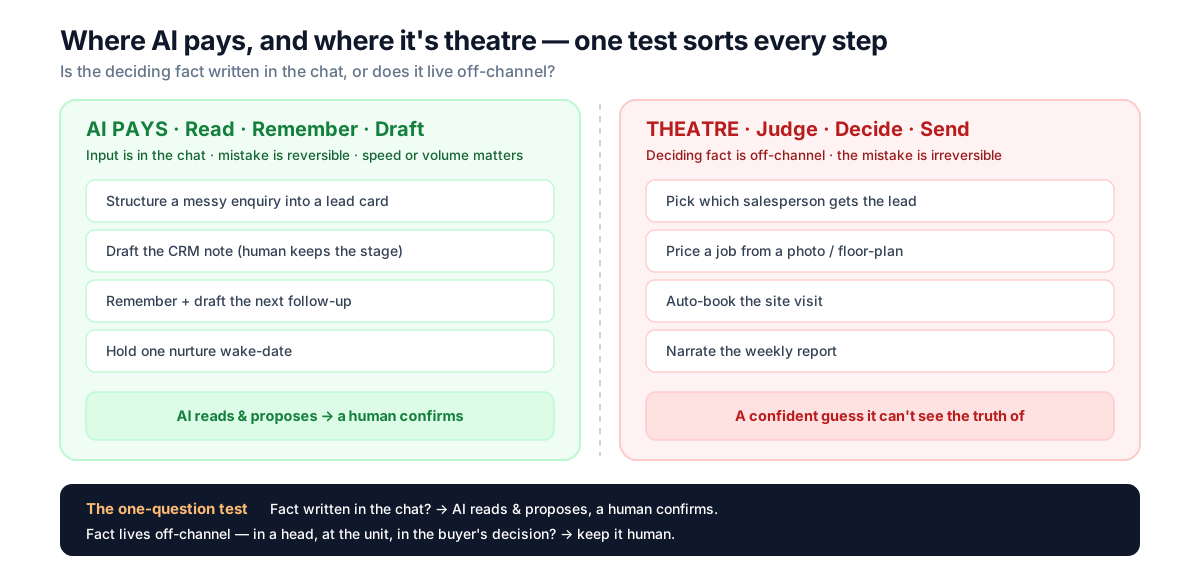
Here's the thing I didn't expect. After building all eight steps, one test predicted every single result — whether a build paid or burned money — before I ran it. It's the same one-question test from the honest-limits piece, generalised: does this job need a fact that's written in the WhatsApp chat, or a fact that lives off-channel?
- If the deciding input is in the thread — the buyer's words, the scope they typed, the quote you sent — AI can read it, and reading is where it's strong.
- If the deciding input is off-channel — in the crew's heads, at the physical unit, in the buyer's unspoken decision, in last month's market — AI can't see it, so it guesses, and it guesses confidently.
Fold in two more properties and you have a reliable filter. AI pays when all three line up; it's theatre when they don't:
Line that filter up against the jobs in the chain and they sort themselves into READ / REMEMBER / DRAFT on one side — where AI earned its keep — and JUDGE / DECIDE / SEND on the other, where it lost money every time.
Which steps paid, ranked?
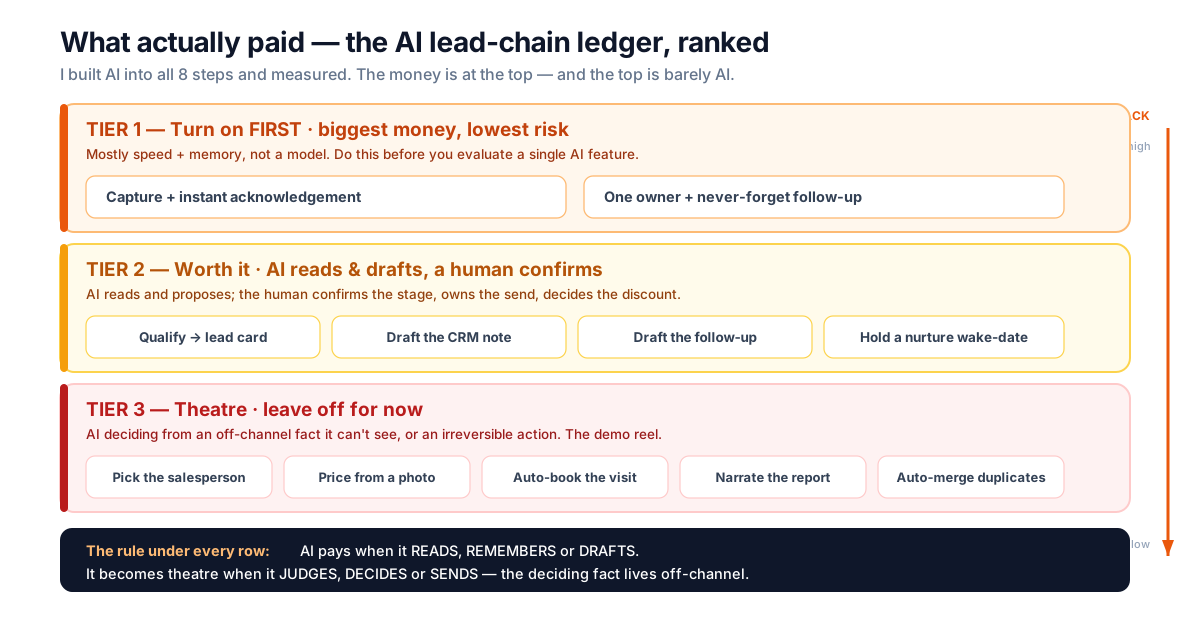
Here's the whole ledger, sorted by payback — what each step cost when done by hand, what AI turned out to be genuinely good for, and whether I'd tell an owner to switch it on. The ranking is the point: the money is concentrated at the top, and the top is mostly not AI.
| Lead-chain step | What it cost by hand | What AI was actually good for | Turn it on? |
|---|---|---|---|
| Capture + instant acknowledgement | Leads sat unanswered while the crew was on a job site; a slow reply quietly halved the odds of ever connecting | An auto-greeting fires in seconds — a template, not a judgment. AI can draft the first real reply, but a human sends it | ✅ First — biggest money, lowest risk |
| One owner + never-forget follow-up | "Lost in the group chat"; 44% of firms quit after one follow-up though 80% of jobs need five-plus | AI remembers who's due and drafts the next touch; the human keeps the timing and the send | ✅ First — pure memory, huge payback |
| Qualify the enquiry | Re-reading a messy Manglish thread to figure out unit, scope, budget | AI reads and structures it into a clean lead card — extract-and-order, never score-and-bin | 🟠 Yes — AI reads, human judges |
| Update the CRM note | ~13 hours a week re-typing WhatsApp into the CRM; pipeline decays either way | AI drafts the summary and fields; the human confirms the stage — auto-setting it corrupts the forecast | 🟠 Yes — draft the note, keep the stage |
| Draft the follow-up / quote chase | The forgotten quote, or the badly-worded price-nag that reopens the number | AI drafts a message that adds a new reason each touch; the human owns the send and the discount call | 🟠 Yes — draft, don't auto-send |
| Nurture the "not this year" pile | Dated leads waiting on keys, loan or bonus get mass-blasted or forgotten | AI extracts the wake-date and drafts one timed message; the human judges if "not now" is real | 🟠 Yes — one wake-date, not a drip |
| Assign to the right salesperson | A black-box pick reps can't audit; best-fit overloads your one closer | AI can tag the lead's language/area; a plain rule does the pick — instant, auditable, trusted | ⛔ Not the pick — AI tags, a rule assigns |
| Price from a photo / floor-plan | Guessing a quote off a phone photo with no scale | AI describes what it sees and flags what's missing — it must never put a size or price on an image | ⛔ Not the price — a number here is a hallucination |
| Book the site visit | Losing a booking because you were up a ladder when the buyer offered times | AI proposes 2–3 slots fast; a human/calendar commits — the crew's real availability is off-channel | ⛔ Not the confirm — a double-booking is irreversible |
| Write the weekly report | Staring at a dashboard, guessing what moved and why | AI flags one number past a threshold and asks one question — it must not narrate a cause | ⛔ Not the narration — weekly rates are noise |
Read top to bottom and the shape is obvious. The two green rows at the top — capture and follow-up memory — are where the real ringgit lives, and neither is really "AI." The amber middle is AI doing what it's good at, reading and drafting, with a human hand on the wheel. The red bottom is the demo reel: every one of them asks AI to make a call using a fact that isn't in the chat.
Why do the boring steps pay first and the flashy ones don't?
Because the biggest leak in a renovation firm isn't a bad decision — it's a lead nobody answered, and a follow-up nobody sent. Fixing those needs speed and memory, not intelligence. That's why the top of the ledger pays first and pays most.
Do the maths on the leak. A busy small firm sees 40–60 enquiries a month, and each one carries roughly RM1,280 of expected gross profit. Lose four winnable ones a month to slow replies and dropped follow-ups and you've leaked tens of thousands of ringgit a year — before anyone made a single judgment about pricing or fit. The response-time research is blunt: a reply in the first few minutes connects at a wildly higher rate than one an hour later, and the first firm to respond wins a large share of competitive deals. On the other end, 44% of firms give up after one follow-up when most jobs need five or more.
None of that is a thinking problem. It's a "was anyone free to reply, and did anyone remember to chase" problem. And that is exactly what a plumbing layer — capture, instant acknowledgement, one owner, an overdue list — fixes, with almost no risk. An auto-greeting can't misjudge a deal. An overdue flag can't hallucinate. The payback is high and the downside is near zero, which is the opposite profile of every flashy build.
The MIT finding rhymes with this. The 5% of pilots that paid weren't running smarter models than the 95% that didn't — they were pointed at bounded, checkable jobs inside a real workflow. In the lead chain, the bounded jobs are read, remember, draft. The unbounded ones — judge, decide, send — are where the 95% lit their money on fire.
Which AI builds should you leave switched off, for now?
Leave off the ones that ask AI to make an irreversible call from a fact it can't see. Not because they're evil — because they demo beautifully and cost you quietly. Here's the theatre list and the one-line reason each fails the test:
- AI picking which salesperson gets the lead. The pick needs to be instant, auditable and trusted by the team — a plain rule ("Mandarin enquiry → Aisyah", "Cheras → the rep nearest site") beats a black box on all three. Worse, "always route to the best-fit rep" overloads your one strong closer until their reply time collapses — the exact speed you were buying. AI belongs on the tag, never the pick.
- AI pricing a job from a photo or floor-plan. You cannot recover real, metric size from a single uncalibrated image — the maths simply throws that information away. So a confident square-footage is a hallucination with a decimal point, and at RM80–450 psf a size off by half bakes thousands of ringgit of error into the quote. AI should describe what it sees and ask for a plan; it must never size the picture.
- AI auto-booking the site visit. The buyer's free times are in the chat, but the crew's real availability and route feasibility are off-channel — in the estimator's head and van route. A missed proposal is recoverable; a confirmed double-booking means you no-show a buyer or bump a paying job. AI proposes slots; a human commits.
- AI narrating your weekly report. A firm doing ~50 enquiries a month closes about one job a week, so a weekly close rate of 1 vs 0 vs 2 wins is 8% vs 0% vs 17% — coin-flips. Ask AI to explain the "trend" and it invents a cause it can't know, because the real reason (a rep on leave, a competitor promo) lives off-channel. Flag one operational number and ask one question — don't narrate.
- AI auto-merging duplicates or auto-filling the lead source. The two mistakes are asymmetric — a missed duplicate is recoverable, a wrong merge silently deletes a real lead, and a wrong source tag quietly poisons the per-channel ROI you set your budget on. AI proposes; a human confirms; it never performs the irreversible action.
Notice the pattern in every one: an off-channel fact, an irreversible action, or noise dressed as signal. That's the theatre tell.
What should an owner actually turn on, and in what order?
Turn it on in the order the money runs — plumbing first, AI-as-drafter second, deciders last (or never). Here's the sequence I'd give any reno, ID or construction firm:
- Turn on the boring high-payback layer first. Capture every enquiry onto one record, acknowledge it instantly, give it one owner by rule, keep a next-action and overdue list. This is most of the money and almost none of the risk. Do this before you evaluate a single AI feature.
- Add AI as a reader and drafter, behind a human tap. Let it structure the lead card, draft the CRM note, draft the next follow-up, hold the nurture wake-date. In every case AI reads and proposes; the human confirms the stage, owns the send, decides the discount. Never wire a draft straight to send.
- Leave the deciders off until they prove themselves on your numbers. Assign-pick, photo-price, auto-book, weekly-narrator, auto-merge. These are the demos. If you ever trial one, trial it shadowed — let it suggest while a human still decides — and watch whether it's ever right about the thing only an off-channel fact would tell it.
- Measure every step in ringgit and hours, not vibes. Did this build save real hours, or get a real lead un-leaked? If not, switch it off without sentiment. The 42% who abandoned their AI in 2025 mostly learned this the expensive way — by turning things on and never checking.
How HotLead fits — honestly
I'll be straight, because over-claiming is the exact hype this whole piece argues against. HotLead does not run your leads with AI behind your back — and after building all of this, I think that's the right call, not a gap. What HotLead ships is precisely the top of the ledger: the boring, high-payback, low-risk layer you should turn on first.
- Capture + auto-greeting. Every WhatsApp, Facebook and Qanvast enquiry lands on one record and gets acknowledged in seconds, so the biggest leak — the unanswered lead — closes before any model is involved.
- One owner, by rule. Round-robin, manual, or a custom rule by area or source — the instant, auditable, trusted assignment the ledger says beats an AI pick.
- Next action + overdue nudges. The never-forget layer that turns "80% of jobs need five follow-ups" from a stat you lose to into a list you work.
- A funnel, per-channel ROI and team performance. The human-read numbers that tell you where leads actually leak and which step to fix — deliberately without an AI narrator, because weekly rates are too noisy to narrate.
The AI builds in this series — auto-scoring, photo-pricing, auto-assigning, report-narration — are experiments I ran to find out what pays, not features quietly running your pipeline. The reading and drafting can help a human go faster; the judgment stays with you, because that's the part of a renovation sale worth paying a person for.
If leaking, mismanaged leads are the real problem underneath all of this, start with the complete guide to managing renovation leads in Malaysia, see how it fits a renovation firm, an interior design studio or a construction contractor, and read the individual build-and-measure pieces — from the first WhatsApp reply to what AI still can't do — to see exactly how each verdict in the ledger was reached.
Sources: The finding that 95% of enterprise generative-AI pilots delivered no measurable P&L return, based on 150 business-leader interviews, 350 employee surveys and 300 public AI deployments, from MIT Project NANDA, The GenAI Divide: State of AI in Business 2025 (report PDF; coverage via Virtualization Review and Fortune). The rise in companies abandoning most of their AI initiatives — from 17% to 42%, with the average firm scrapping ~46% of proofs-of-concept before production, across a survey of 1,000+ enterprises — from S&P Global Market Intelligence, 2025 (see also AgenticWork's summary). All step-level verdicts, before/after costs and failure modes are drawn from the individual build-and-measure experiments in this series, each linked inline and each labelled at the time as an experiment rather than a shipped feature; the per-step AI cost (0.1 sen per read/draft) and any composite hours or ringgit figures are described from practice and labelled illustrative, not a controlled trial or a quoted price. Renovation operating figures reused from earlier pieces and labelled typical — 40–60 enquiries a month, ~7–8% close rate, ~RM1,280 expected gross profit per enquiry (cost of a lost lead, four numbers to track); the ~13 hours/week of CRM data entry, the 44%-quit-after-one and 80%-need-five follow-up figures (Invesp), the response-time-to-connect curve and first-responder advantage, and the ~90.7% WhatsApp-for-business figure are all reused with their original sources from the linked pieces in this series.
Frequently asked questions
Is AI actually worth it for managing renovation leads in Malaysia?
For some steps, clearly yes — for others it loses you money. After building AI into all eight steps of the lead chain and measuring each, the pattern was consistent — AI paid where the job was to read the WhatsApp thread, remember a task, or draft a message (structuring a messy enquiry, drafting a follow-up, holding a nurture wake-date), because the input is right there in the chat, the stakes are low, and a human confirms before anything irreversible happens. It lost money where the job was to make a judgment that needs a fact the chat doesn't hold — picking the right salesperson, pricing a photo, deciding a deal is dead. So the honest answer isn't "AI good" or "AI bad", it's which job in the chain you point it at. Point it at reading and drafting, keep the deciding human.
What AI should a small renovation or interior-design firm turn on first?
Turn on the boring layer first, because that's where the money is and the AI risk is lowest — capture every enquiry onto one record, acknowledge each one instantly, give it one owner by rule, and keep a next-action and overdue list so nothing gets forgotten. Most of that isn't even AI; it's speed and memory. That layer alone closes the biggest leak, because a five-minute reply massively out-connects a two-hour one and 44% of firms give up after a single follow-up. Only once that's running should you add AI as a drafter behind a human tap — a lead-card summary, a CRM note, a drafted follow-up you approve before it sends. The order matters — the plumbing first, the model second.
Which AI lead tools are just hype for a firm my size?
The ones that ask AI to make an irreversible decision from information that isn't in the chat. In my experiments that meant — AI picking which salesperson gets a lead (a plain rule is faster, auditable, and trusted, and best-fit routing quietly overloads your one strong closer); AI pricing a job from a photo or floor-plan (you can't recover real size from an uncalibrated image, so the number is a confident guess); AI auto-booking a site visit (the crew's real availability and route live off-channel); and AI narrating your weekly report (a firm your size closes about one job a week, so weekly rates are coin-flip noise the AI dresses up as a trend). None are useless forever — they're just where money burns today, which is exactly why MIT found 95% of enterprise AI pilots showed no measurable return in 2025.
Does HotLead use AI to run my leads for me?
No, and that's deliberate — the parts of the lead chain that pay the most aren't AI, and the parts where AI is risky shouldn't run unattended. HotLead ships the high-payback layer — it captures every WhatsApp, Facebook and Qanvast enquiry onto one record, auto-greets so no lead sits unanswered, routes each to one owner by round-robin, manual or a custom rule, keeps a next-action and overdue list, and shows you a funnel, per-channel ROI and team performance. The AI builds described in this series — auto-scoring, photo-pricing, auto-assigning, weekly-report narration — are experiments I ran to find out what pays, not features that run your pipeline behind your back. The judgment stays with you, because that's the part worth paying a human for.
How do I know whether an AI step is actually paying for itself?
Measure it in the only two currencies that matter — hours saved and leads that didn't leak — per step, against what the same step cost you done by hand. A drafting step that saves your team real hours a week on data entry and gets follow-ups out is paying. A "smart" step that produces a confident output you then have to double-check every time is costing you, even if it demos well. The trap S&P Global found in 2025, when 42% of companies abandoned most of their AI initiatives, is turning on impressive-looking builds and never checking the P&L — so if a build doesn't move your per-enquiry leak or your hours, switch it off without sentiment. In renovation, that leak is roughly RM1,280 of expected gross profit per enquiry, so the maths is not subtle.
Keep reading
- How Often Should a Renovation Firm Check Each Number? The Review Rhythm That Fits a Malaysian FirmMost reno owners refresh revenue and the bank balance daily — the two numbers they can do least about — and never review the ones they could still fix this week. Here's how to set each number's review frequency by how fast it moves and whether you can act on it, with a daily, weekly and monthly rhythm built for a WhatsApp-run Malaysian firm.
- The Lead Who Can't Say Yes: Selling a Renovation When the Decider Isn't in the ChatThe person messaging you about the renovation often isn't the one who signs off the job — it's a wife gathering quotes while the husband holds the budget veto, an adult child sourcing for aging parents, one sibling of a jointly-owned unit. So you pour your whole pitch, quote and follow-up into someone who can't actually say yes, and the deal dies in a family discussion you were never invited to. Here's how to spot the messenger early and get the real decider into the room — without insulting the one who chose you.
- "Can Discount Ah?" Can AI Spot a Price-Shopping Renovation Lead — and Should It Decide the Next Move?A Puchong contractor gets "another firm quoted me RM55k, can match or not?" at 10pm and does what a tired owner does — he knocks RM6k off to not lose it. He's trained that buyer, and the ten after her, to push. So the 2026 reflex is to ask AI to read the thread, flag the price-shoppers, and either auto-discount to win them or bin them as tyre-kickers. I built it. It mislabels your best buyer as a time-waster and your margin as negotiable — because the signal is in the chat but the right move never is. Here's the build that earns its keep, and why "can discount ah?" is the start of a conversation, not a verdict.