


Ask most renovation-firm owners what wins a job and they will talk about price, or speed, or the quality of the quote. Almost none will mention the deposit — the number they ask for at the moment the buyer says yes. Yet that number does two jobs at once: it is the conversion event of your entire funnel — the point a warm lead becomes a paid deposit — and it is the first, biggest lever on your cashflow. Get it wrong in either direction and you either lose the lead at the finish line or win a job that quietly starves you of the cash to serve the next one.
This is the money-mechanics piece the funnel benchmarks and pipeline-value articles stop just short of. Both treat the paid deposit as the win. This one is about how you structure that deposit — and why the answer decides not just whether you close, but which leads you can afford to chase at all.
What is a normal renovation deposit in Malaysia?
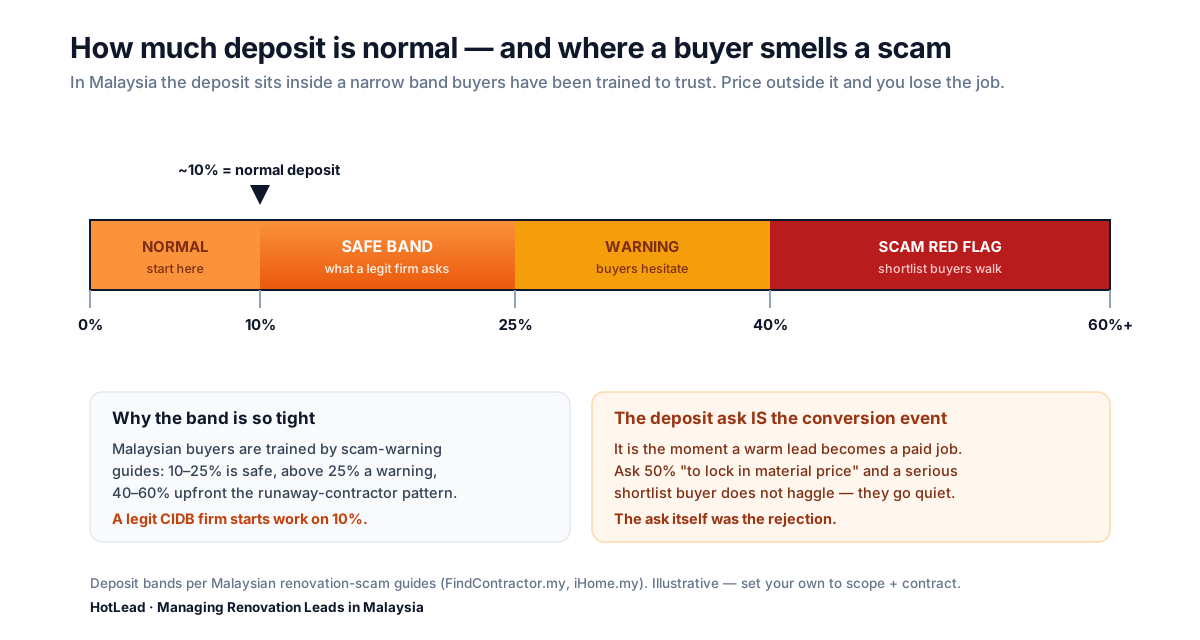
About 10% of the total cost on signing is normal, and a safe upfront band runs from 10% to roughly 25%. Above 25% is treated as a warning; a demand for 40% to 60% before any work begins is the textbook scam red flag. A legitimate, CIDB-registered contractor can start on a 10% deposit — they do not need half the job in the bank to buy the first pallet of tiles.
What makes this un-Googleable for a Malaysian firm is why the band is so tight. Buyers here are not guessing — they have been actively trained. Malaysia's renovation-content ecosystem is thick with scam-warning guides, and they all say the same thing: FindContractor.my and iHome.my both put the safe deposit at 10–25%, flag anything above 25%, and single out 40–60% upfront as the runaway-contractor pattern. Serious buyers who shop three to five firms on Qanvast or Atap have usually read one of these before they message you.
The deposit sits inside a band, and the band is a trust signal. Price yourself outside it — even for a legitimate reason — and you look like the thing buyers have been warned about.
What does a typical progressive-payment schedule look like?
The balance after the deposit is broken into tranches, each released only when a defined stage is finished and inspected — not paid upfront. A common Malaysian residential structure looks like this, and most interior-design firms run some version of it:
| Milestone | % of contract | What's done | Your cash position |
|---|---|---|---|
| Deposit on signing | 10% | Contract signed, materials ordered | You front early material + labour |
| After hacking & tiling | 20% | Wet works, floor and wall tiling done | First real top-up |
| After carpentry | 25% | Built-ins, kitchen, wardrobes installed | The biggest material outlay recovers |
| After electrical & painting | 25% | Wiring, lights, full paint complete | Nearly whole |
| Completion & handover | 20% | Snagging, cleanup, keys back | Balance, minus retention |
That 10 / 20 / 25 / 25 / 20 split is illustrative — the exact percentages vary by firm and scope — but the shape is the point: you are paid as you deliver, so you are never financing the entire job from your own pocket. Malaysian buyers already understand this rhythm, because they met it when they bought their under-construction home: the progressive-payment schedule under Schedule H of the Housing Development Act bills them roughly 10% on signing the sale-and-purchase agreement, then tranches as each construction stage completes, with a slice held back through the defect-liability period. Framing your reno schedule in that same language borrows trust you did not have to build.
Two things owners forget to price in:
- Retention. The buyer will typically hold back 5 to 10% of the final payment until snagging is done and they have signed off. That is normal and fair — but it means a won job is not a collected job. A chunk of your money sits with the client through the defect period.
- The trough. Even a clean schedule leaves you out of pocket between milestones — you buy the tiles now and get paid at the after-tiling stage. On a well-structured job the trough is shallow. On a badly-structured one, it swallows you.
Why can a won job on the wrong terms be worse than a lost lead?
Because a lost lead costs you only the expected profit, while a cash-negative job ties up the working capital you need to win and deliver the next three. This is the contrarian point most owners miss, and it flips how you think about a "win."
When you lose a lead, the real cost is the expected gross profit — roughly RM1,280 per winnable enquiry on the house math (job value × margin × conversion). Painful, but bounded, and it does not touch your bank balance. A won job on back-loaded terms is different. If you agree to a small deposit and "the rest on completion," you have quietly become the client's interest-free financier: you buy the materials, pay the labour, carry the whole cost for weeks — and only get whole at the end, minus retention, if they pay on time. That is not revenue you can use. It is capital locked in someone else's home.
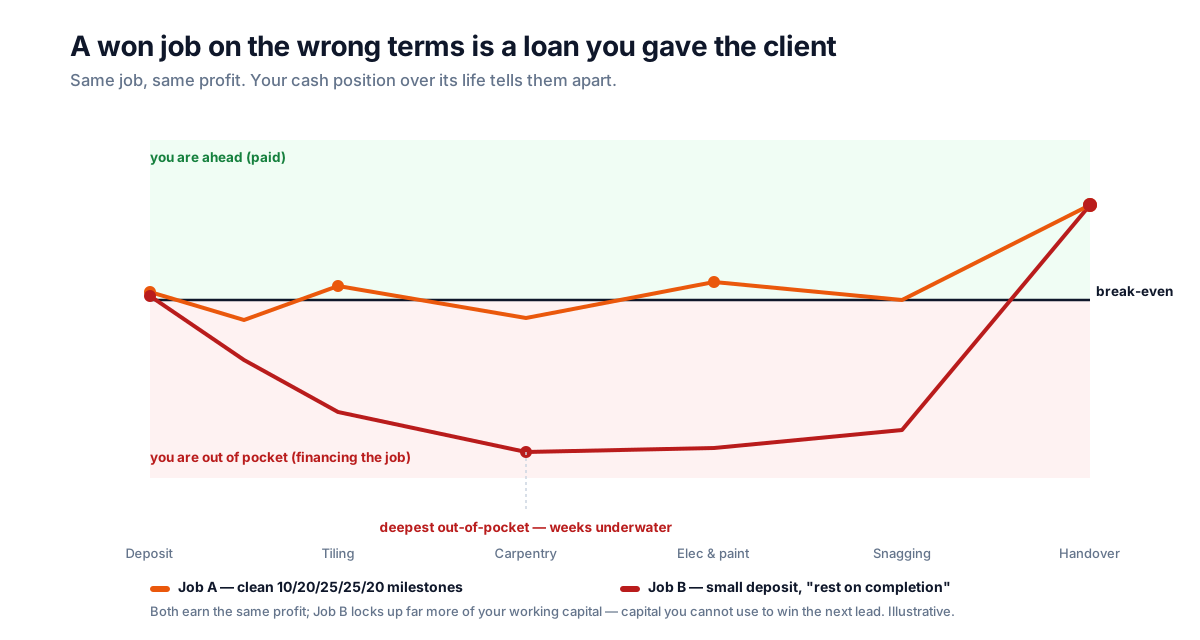
The trap is that both jobs show up identically on your pipeline forecast and your close-rate — same value, same margin, both "won." Only the cashflow tells them apart. And cash, not the P&L, is what fails a small reno firm: you can be profitable on paper and still miss payroll because RM120k of your money is sitting in two half-finished jobs whose owners are slow to release the next tranche.
How do payment terms change which leads you should chase?
Two leads of the same size and margin are not worth the same if one pays a clean deposit on milestones and the other wants to pay mostly at the end. Once you accept that, payment structure becomes a lead-management input, not just a contract clause — and it changes your priorities in two concrete ways.
First, it re-ranks the pipeline. The weighted pipeline tells you which deals matter by value and probability. Payment terms add a third axis: cash. A RM90k job on a clean 10/20/25/25/20 schedule is a genuinely better lead than a RM110k job the buyer wants to pay 20% now and 80% on completion — the bigger job is the one that will strangle you. When you are capacity-limited (and every small reno firm is), the job you can cashflow beats the job that is merely larger.
Second, the deposit conversation is a qualification signal you should catch on the first call. A buyer who resists any deposit, pushes hard for back-loaded terms, or bristles at a normal 10% is telling you something — about their commitment, or about their own cash position, or both. That is exactly the kind of thing you want to surface during qualification, before you have burned a site visit and drafted a full quote, not after. It does not mean auto-rejecting them — a first-home buyer waiting on loan disbursement is a real, winnable lead on a known clock. It means knowing, early, which conversation you are in.
So what's the honest way to set your terms?
Price the deposit inside the band buyers trust (around 10%, never above 25% without a very good, well-explained reason), structure the balance as progressive payments tied to inspected milestones, expect a 5–10% retention you will not see until snagging is signed, and treat the whole schedule as a qualification and cashflow tool, not just a payment plan. The firms that do this do not just get paid more reliably — they win more of the jobs they quote, because the terms themselves read as competent and safe in a market primed to fear the opposite.
| The decision | The lazy version | The version that pays |
|---|---|---|
| Deposit % | "Ask for as much as I can get" | Sit in the 10–25% trust band; default 10% |
| The balance | "Rest on completion" | Progressive milestones, each inspected |
| Retention | Forgotten until the client withholds it | Priced in — a won job is not yet collected |
| Which leads to chase | By job size | By size and the cash the terms free up |
| The deposit ask | An invoice detail | A conversion moment and a qualification signal |
How HotLead fits — and where it doesn't
Be clear on the boundary: HotLead is lead management, not invoicing. It does not schedule progressive payments, issue milestone invoices, or hold retention — that lives in your accounting or contract tooling. What HotLead does is manage everything up to and including the deposit, which is the conversion event this whole article is about, for Malaysian renovation, interior-design and construction firms on the WhatsApp they already use:
- Qualify on the first reply — capture budget, timeline and commitment signals (including how a buyer reacts to a normal deposit) as structured fields, so a back-loaded-terms risk surfaces before you pour hours in.
- Next-action and overdue flags — so the warm quote waiting on a deposit decision is a tracked task that gets chased, not a message that scrolls out of sight.
- A funnel and per-channel view in ringgit — so you can watch quote-to-paid-deposit conversion by source and see which channels send buyers who actually sign, not just enquire.
Start with the complete guide to managing renovation leads in Malaysia, read what a lost lead really costs or why interior-design quotes stall at the deposit, or see the renovation, interior-design and construction playbooks.
Sources: Malaysian renovation deposit norms and progressive-payment structures (10% normal deposit, 10–25% safe band, above 25% a warning, 40–60% upfront a red flag; the 10/20/25/25/20 milestone split; 5–10% retention held to snagging; most ID firms use progressive payments) — FindContractor.my, "5 Renovation Scams in Malaysia" (2026), iHome.my, "How to Avoid Renovation Scams in Malaysia" (2026), and RumahHQ's renovation-budget guide. Property progressive-payment schedule under Schedule H of the Housing Development Act as the cultural anchor — PropertyGuru Malaysia, "Progressive Payment Schedule for a Property Under Construction". Construction-industry payment reality and the Section 3 residential exemption — AIAC / KLRCA CIPAA Circular 1A on the scope of CIPAA, with late-payment and SME cashflow context from PLANNING MALAYSIA, "Late Payment Issues of Subcontractors in the Malaysian Construction Industry". Job-value, margin and expected-profit figures (condo ~RM40k–150k, ~18–25% residential gross margin, ~7–8% blended conversion, ~RM1,280 expected gross profit per winnable enquiry) are the house figures from the cost-of-a-lost-lead and funnel-benchmark pieces. Payment percentages and cashflow examples in this article are illustrative — set your own deposit, milestone splits and retention to your scope and contract.
Frequently asked questions
What is a normal deposit for renovation in Malaysia?
About 10% of the total project cost on signing is normal, and legitimate CIDB-registered contractors can start work on that. A safe range is roughly 10 to 25% upfront. Above 25% should be treated as a warning sign, and a demand for 40 to 60% before any work begins is a classic red flag that widely-read Malaysian renovation-scam guides tell buyers to walk away from. Never pay 100% upfront. The balance should be released in stages tied to completed, inspected work.
How do progressive payments work for a renovation?
The total cost is broken into tranches, each released only when a defined stage is finished and inspected rather than all upfront. A common Malaysian structure is 10% deposit, 20% after hacking and tiling, 25% after carpentry, 25% after electrical and painting, and 20% on completion and handover — the exact split varies by firm and scope. Most interior-design firms run payments this way. It protects the homeowner from paying for work not done, and it protects the contractor from financing the whole job out of pocket.
What is a retention sum in a renovation contract?
Retention is a small percentage — typically 5 to 10% of the contract value — that the homeowner holds back from the final payment until snagging is complete and they have signed off on defects. It gives the buyer leverage to get problems fixed before the contractor is fully paid. From the contractor's side it means a won job is not a collected job — a slice of your money sits with the client through the defect period, so your cash position lags your sales figure.
Does CIPAA protect a renovation contractor from late payment?
Usually not, for a homeowner job. The Construction Industry Payment and Adjudication Act 2012 gives the construction industry a fast track to resolve payment disputes, but Section 3 exempts a contract entered into by a natural person for work on a building under four storeys wholly intended for their own occupation — which describes most home renovations. So on a typical residential reno the contractor has no CIPAA adjudication backstop, and the deposit plus a milestone schedule are the only real cashflow protection. On commercial jobs and subcontract chains, CIPAA does apply.
Should payment terms affect which renovation leads I chase?
Yes. Two jobs of the same size and margin are not worth the same if one pays a clean deposit on milestones and the other wants to pay mostly at the end. The second is a loan you are extending to the client, and the working capital it ties up is capital you cannot use to serve other leads. A buyer who resists any deposit or pushes hard for back-loaded terms is also giving you a qualification signal — about their commitment and their own cash — worth catching on the first call, not discovering after you have poured hours in.
Keep reading
- Did We Already Say RM68k? Using AI to Stop Quote Drift Across a Long Renovation ThreadOver a weeks-long WhatsApp thread with two or three quote revisions, a rep re-states a number that contradicts an earlier promise — and re-opening a settled price quietly invites a discount that eats a whole job's profit. So I pointed AI at the drift. It works beautifully as a flag, and dangerously as an auto-corrector.
- The Warranty as a Closing Lever: Why a Longer Guarantee Beats a Discount on a Renovation DealA quote is stalling and the buyer wants a reason to say yes. Before you drop the price, look at the other lever in your hand — a longer workmanship warranty. It is the same expected-value decision as a discount, but the math runs the opposite way — a price cut costs you thousands with certainty, while extending the defects cover costs you a couple of hundred ringgit in expectation, for arguably more trust with a scam-wary buyer. Here is the EV case for the non-price concession, the trap that turns it into a hidden liability, and which leads it actually moves.
- "Can You Just Build It, My Neighbour Also Did" — Handling the Renovation Lead That Needs Council Approval FirstSome renovation enquiries can't legally start next month, no matter how ready the buyer is — a kitchen extension, a hacked-through wall, a roofed-over air well all need the council's written approval first. Quote a fast build price to win the job and you either lose it to a "boss, can start" cowboy, or win it and inherit the stop-work order, the RM50,000 fine and a client who later can't sell the house. Here's how to spot the permit-first lead and sell the approval as protection.