
An owner I know switched on one of those "AI handles your leads" tools this year and watched it work for a month. Honestly? It was good. It logged every WhatsApp enquiry, replied in seconds, tidied messy paragraphs into clean lead cards, even wrote a decent follow-up. Six of the eight steps in his lead process, it did faster and more patiently than his two-person team ever had.
Then it lost him two jobs he should have won — quietly, while looking like it was doing everything right. And that's the 2026 question worth answering honestly, because everyone is selling the upside: where, exactly, does AI stop paying in a contractor's lead process — and can you predict it before it costs you a deal?
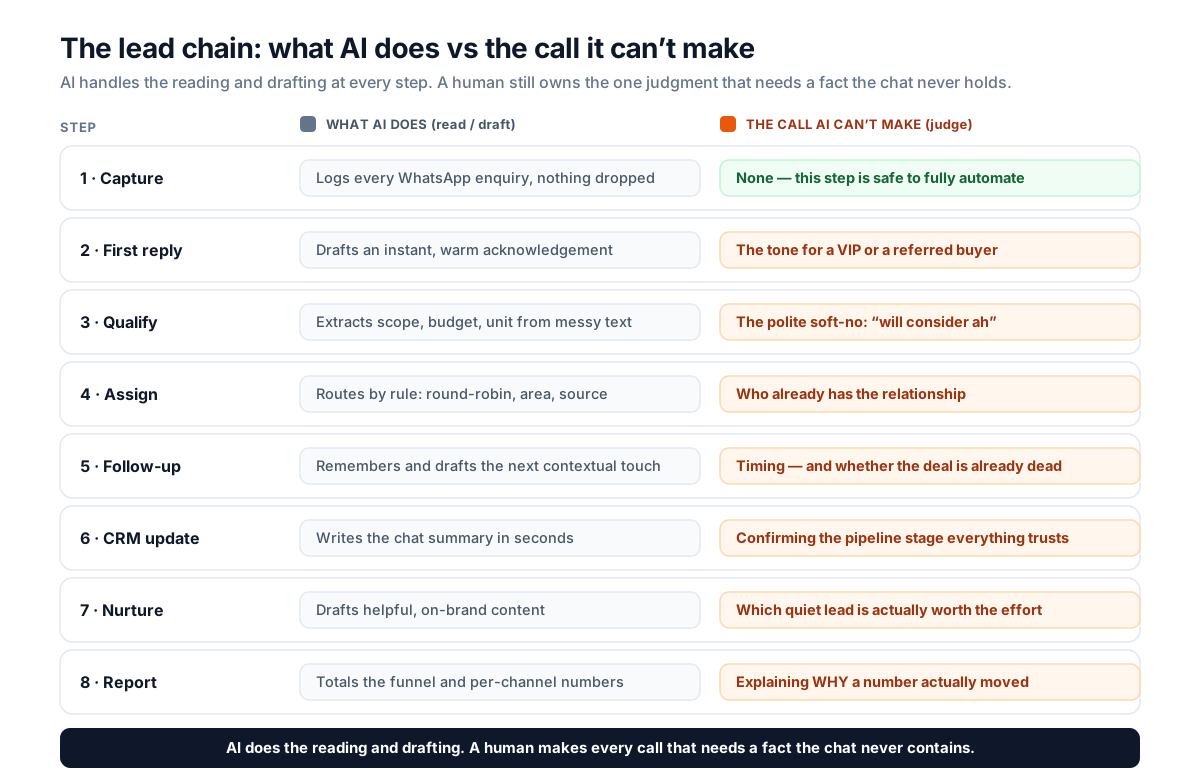
So I mapped the whole chain — capture, first reply, qualify, assign, follow-up, CRM update, nurture, report — put AI on every step, and watched where it earned its keep and where it started guessing. The pattern was clean, and it wasn't where the hype (or the fear) says it is. Here's the honest map, the one test that predicts every limit, and what a Malaysian reno or construction owner should actually do with it.
Where does AI actually fail in a lead process — the writing or the judging?
The judging, every time. Not the writing. This is the single most useful thing I learned, and it's the opposite of what most owners brace for.
AI writes beautifully. Told to acknowledge an enquiry, it produces a warmer, faster, better-spelled reply than a tired owner thumbing WhatsApp between two site visits. Told to summarise a chat, it nails it. The parts people assume are "too human for a machine" — tone, phrasing, politeness — are the parts AI does best. Where it falls over is the quiet judgment calls: is this "maybe later" a real maybe or a soft no? Is this silence a dead deal or a busy buyer? Should this quote hold firm or flex? Those aren't writing problems. They're decisions, and AI makes them badly for one specific reason.
That's the whole thesis, so here it is plainly. Every place AI reliably fails in the lead process is a place where the deciding information lives off-channel — in the owner's memory of the site visit, in a relationship, in the market, in a tone that Malaysian buyers use precisely so they don't have to say the hard thing out loud. AI reads the WhatsApp thread perfectly. It just can't read the things that aren't in it.
What can AI reliably do across the eight steps?
Plenty — and pretending otherwise is its own kind of hype. Being anti-hype doesn't mean being anti-AI; it means being honest in both directions. So before the limits, the credit, because this half is real and cheap: at illustrative small-model pricing these tasks cost a fraction of a sen each, the same rounding error we measured in the first-reply experiment.
- Capture. AI logs every enquiry across WhatsApp, forms and ad leads so nothing is dropped. This step is safe to fully automate — there's no judgment in it.
- First reply. It drafts an instant, on-brand acknowledgement, killing the slow-response leak covered in how fast you should reply.
- Qualify. It extracts scope, budget and unit from a rambling paragraph into a clean card.
- Follow-up drafting. It remembers the quote and writes a contextual next touch so nothing goes cold.
- CRM notes. It summarises the conversation in seconds.
- Reporting. It totals the funnel and per-channel numbers without a spreadsheet.
Six genuinely useful jobs. None of them is where the money leaked. The leak was in the decisions stacked on top of them.
What's the one test that predicts every limit?
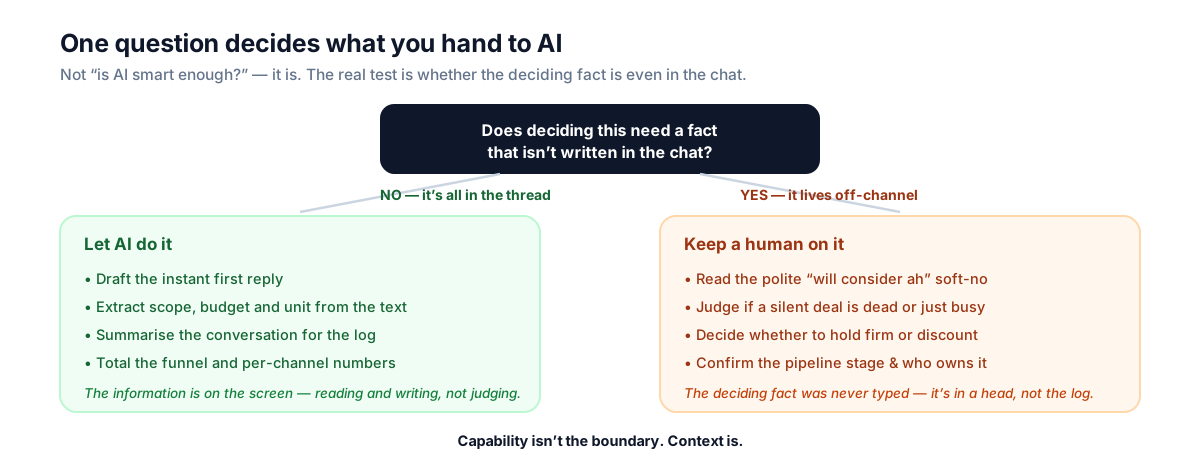
Ask a single question of any step: does deciding this need a fact that isn't written in the chat?
If the answer is no — the information is all in the thread — hand it to AI. Drafting a reply, extracting a scope, summarising a conversation, adding up a funnel: the model has everything it needs on the screen. If the answer is yes — the deciding fact lives in someone's head, on the site visit, in the relationship, in the market — keep a human on it. That's the entire boundary. Not "is AI clever enough," but "is the deciding fact even in the data I gave it."
Run the eight steps through that test and the map draws itself — six read-and-write jobs on one side, a short list of context-dependent judgments on the other.
The honest map: what AI does at each step vs the call it can't make
Here's the whole chain, step by step, with the exact judgment AI can't make and the off-channel fact that judgment needs.
| Step | What AI does well (read / draft) | The call it can't make | The fact that call needs — not in the chat |
|---|---|---|---|
| 1 · Capture | Logs every enquiry, nothing dropped | (none — safe to automate) | — |
| 2 · First reply | Drafts an instant warm reply | The tone for a VIP or referred buyer | That this number came from your best client |
| 3 · Qualify | Extracts scope, budget, unit | Reading the polite soft-no | That "will consider ah" means no in Manglish |
| 4 · Assign | Routes by round-robin, area, source | Who already has the relationship | That your PM golfed with this buyer's boss |
| 5 · Follow-up | Remembers and drafts the next touch | Timing, and whether the deal is dead | That they signed with a rival last Tuesday |
| 6 · CRM update | Writes the chat summary | Confirming the pipeline stage | That the buyer's smile on-site was a stall |
| 7 · Nurture | Drafts helpful content | Which quiet lead is worth the effort | That this "small job" owns three more condos |
| 8 · Report | Totals the funnel | Explaining why a number moved | That last month's spike was one referral |
Look down the right two columns. Every single one is a fact that was never typed into WhatsApp — because it happened on a site visit, in a relationship, in the market, or inside a buyer's head. That's not a coincidence. That is the limit.
Why is a confident wrong answer the real danger?
Because a fluent, official-looking mistake is one nobody double-checks — and the research on this is blunt. In the Harvard Business School–BCG field experiment "Navigating the Jagged Technological Frontier", 758 consultants were given real tasks. On work inside AI's frontier, those with GPT-4 produced over 40% higher quality and finished faster. But on a task outside the frontier — one needing judgment the model didn't have — the people without AI were right 84.5% of the time, while those leaning on AI dropped to 70.6%. The AI users didn't fail from laziness; they failed by trusting a confident, well-written wrong answer and following it off a cliff.
That is precisely the failure mode in a lead process. When AI reads "let me discuss with my wife first, will consider ah" and logs the deal as Open · warm, it isn't being lazy — it's being fluently, confidently wrong. And because the CRM entry looks official, the overdue-follow-up list keeps that dead lead alive for weeks while a live one two rows down gets ignored. The tool didn't just make a mistake; it made a mistake wearing a suit.
What makes this specifically a Malaysian problem?
Because the deciding facts here hide in ways a text-reading model is especially blind to. Three that came up again and again:
- The polite soft-no. Malaysian buyers rarely say "no thanks." They say "will consider ah," "let me discuss with my wife first," "not now lah, maybe later." A human reads the decline instantly; AI reads a live lead. This is the single most common misfire, and it corrupts exactly the load-bearing field — the pipeline stage — which is why our CRM-update experiment landed on letting AI draft the note but keeping the stage a one-tap human call.
- Tender judgment. For a contractor, a WhatsApp enquiry might be a private reno or an invitation to bid — and whether you should bid depends on your CIDB grade, your current site load and the client relationship, none of which is in the message. AI can't tell a G3 firm that this project is above its grade limit, or that a "small job" from a repeat developer is worth dropping everything for. That two-lanes-one-inbox reality is the whole subject of tender enquiries versus direct leads.
- The bargaining reflex. In a market where "can give discount ah?" is a warm-up, not an insult, a clumsy AI follow-up whose only content is your price is an open invitation to negotiate. A human knows when silence means "waiting on the bank loan" versus "shopping you against a cheaper quote." AI just sees unread ticks.
What should an owner actually do on Monday?
Don't skip AI, and don't hand it the whole pipeline. Split the chain along the one test — and the split pays for itself because you keep the cheap speed and the expensive judgment.
- Let AI own the reading and drafting. Capture, first-reply drafts, qualification extraction, note-taking, reporting. These are fast, cheap and low-risk. Not using AI here is leaving free speed on the table.
- Keep a human on the four judgments. The stage verdict, the timing of a chase, the discount decision, and whether a deal is dead. Each needs a fact off the screen. Let AI suggest; make a person confirm with one tap.
- Treat every AI status as a draft, never a fact. The Harvard–BCG lesson is that fluent output invites blind trust. Build the habit that an AI-set stage is a suggestion a human okays — especially on any "maybe later."
- Watch your soft-no rate. If your CRM is full of warm leads that never move, AI is almost certainly logging polite rejections as live deals. That's the tell that the judgment layer needs a human back in it.
How HotLead fits — and what it deliberately doesn't do
I'll be straight, because over-claiming is the hype I keep arguing against. HotLead is built on exactly this split, and it deliberately doesn't automate the judgment half:
- It captures every enquiry and gives each lead one owner — so the human who remembers the site-visit ceiling and the relationship is the one making the call.
- It keeps a next action and an overdue-follow-up nudge so nothing is forgotten — the memory layer, surfaced to a person, not an auto-chaser firing blind.
- It routes by round-robin, area or custom rule, and shows a funnel and per-channel view so you can see where leads leak and fix the right step.
- Its optional AI assistant warms a brand-new enquiry instantly — the safe, in-the-chat half — while the stage verdict, the chase timing and the "is this dead" call stay human, by design.
That restraint is the point, not a gap. HotLead automates the six steps where the fact is on the screen and hands you the judgments where it isn't. If leaking leads are your problem, start with the complete guide to managing renovation leads in Malaysia, see how it fits a construction or contracting firm, or read the companion builds on AI first replies and auto-updating the CRM.
Sources: AI-on-tasks-inside-vs-outside-the-frontier findings (over 40% quality lift inside the frontier; accuracy falling from 84.5% without AI to 70.6% with it on tasks outside the frontier, via over-reliance on confident wrong output; 758 BCG consultants) from Dell'Acqua, McFowland, Mollick et al., "Navigating the Jagged Technological Frontier" (Harvard Business School / BCG, 2023), summarised in Forbes and the HBS AI Institute. Malaysian AI adoption (27% of businesses / 2.4M using AI, up from 20% in 2024; 73% on basic uses only; 52% cite a shortage of skilled personnel as the top barrier) from the AWS-commissioned study "Unlocking Malaysia's AI Potential," reported by TNGlobal and Tech Wire Asia. WhatsApp lead-channel share (~90.7%), expected-gross-profit-per-lead and CIDB tender mechanics as established in the complete guide, the tender-versus-direct-leads piece and the cost of a lost renovation lead. Illustrative per-task compute cost as derived in the first-reply experiment. The polite soft-no ("will consider ah") as a field-observed Malaysian buyer pattern, discussed in the AI CRM-update experiment; described here from practice, not a published statistic.
Frequently asked questions
What parts of a contractor's lead process can AI safely handle?
The reading and drafting parts, where all the needed information is already in the message. AI reliably logs every WhatsApp enquiry so none is dropped, drafts an instant warm first reply, extracts the scope, budget and unit from a messy paragraph, summarises a conversation into a note, and totals your funnel and per-channel numbers. These are read-and-write tasks — the deciding information is on the screen — so they are cheap, fast and low-risk to automate. The steps to keep human are the judgment calls that depend on a fact the chat never contains.
What can't AI do in a renovation or construction firm's lead pipeline?
It can't make the judgment calls that ride on off-channel context. It can't read a polite Malaysian soft-no like "will consider ah" as a rejection, decide whether a week of silence means the deal is dead or the buyer is just busy on site, know that the homeowner told you on the site visit that RM70k was her hard ceiling, judge which quiet lead is worth chasing, or confirm the pipeline stage that your forecast and follow-up list depend on. Each of those needs a fact that was never typed into WhatsApp — so AI is guessing, and a confident guess in your CRM is worse than an honest blank.
Isn't AI's limitation just that it sounds robotic or lacks empathy?
That's the myth, and it's backwards. A modern model writes a warmer, more patient, better-punctuated reply than a rushed owner texting between site visits — tone is one of the things it does best. The real limitation is judgment on missing context. AI can sound perfectly human while being confidently wrong about whether a deal is alive, because the tone is in the words and the truth is not. Chasing "it doesn't sound human enough" is solving the wrong problem.
How do I decide which lead-process tasks to give AI and which to keep human?
Use one question, step by step. Ask "does deciding this need a fact that isn't written in the chat?" If the answer is no — drafting a reply, extracting the scope, summarising the thread, adding up the funnel — the information is all on the screen, so let AI do it. If the answer is yes — the verbal budget ceiling, the relationship, whether the silence means dead, the true pipeline stage — keep a human on it. Capability isn't the boundary; context is. The map in this article walks all eight steps through that test.
Does HotLead automate the parts of the lead process that AI can't do?
No — deliberately. HotLead captures every enquiry, gives each lead one owner, keeps a next action and an overdue-follow-up nudge so nothing is forgotten, routes by round-robin, area or custom rule, and shows you a funnel and per-channel view. Its optional AI assistant warms a brand-new enquiry instantly. What it does not do is auto-set your pipeline stage, fire chasers on its own, or decide a deal is dead — the exact judgment calls that need context AI can't see. It automates the safe half and surfaces the rest to the human best placed to judge.
Keep reading
- The Only Three Ways to Grow a Renovation Firm — and Which Lever to Pull FirstEvery renovation firm's revenue comes down to three levers — how many leads you get, how many you close, and how big each job is. They multiply, so a modest lift on each compounds. But they cost wildly different amounts to pull, and most owners reach first for the one they should reach for last. Here's the ranking, with Malaysian numbers.
- Sight Unseen: Winning the Overseas Malaysian Who Renovates a Unit They Can't VisitA Malaysian working in Singapore collects the keys to a KL condo and messages you to fit it out — but they can't come to a site visit, can't walk your showroom, and will wire a deposit to a firm they've never met. Most firms treat this lead like a walk-in, go quiet when the buyer can't pop by, and lose the highest-budget job in the inbox. Here's why the remote buyer is your hardest-trust but best-paying lead, and how to build a remote lane that actually closes it.
- "Ok, Proceed" Isn't Money in the Bank — I Built an AI to Ask for the Deposit the Moment a Renovation Buyer Says YesA Cheras contractor closes a RM62k job on WhatsApp, the buyer says "ok proceed lah", and then the owner — mid-site, phone in a dusty hand — has to stop, pull the bank details, the agreed deposit and the scope, and type a careful money message. In that gap a hot yes quietly cools back to "let me think." The 2026 reflex is to ask AI to detect the yes and auto-fire the invoice. I built it, and it asked a half-committed buyer for 40% to a personal account two seconds after a soft "ok ok". Here's the version that kills the typing delay without asking for money off a misread.